
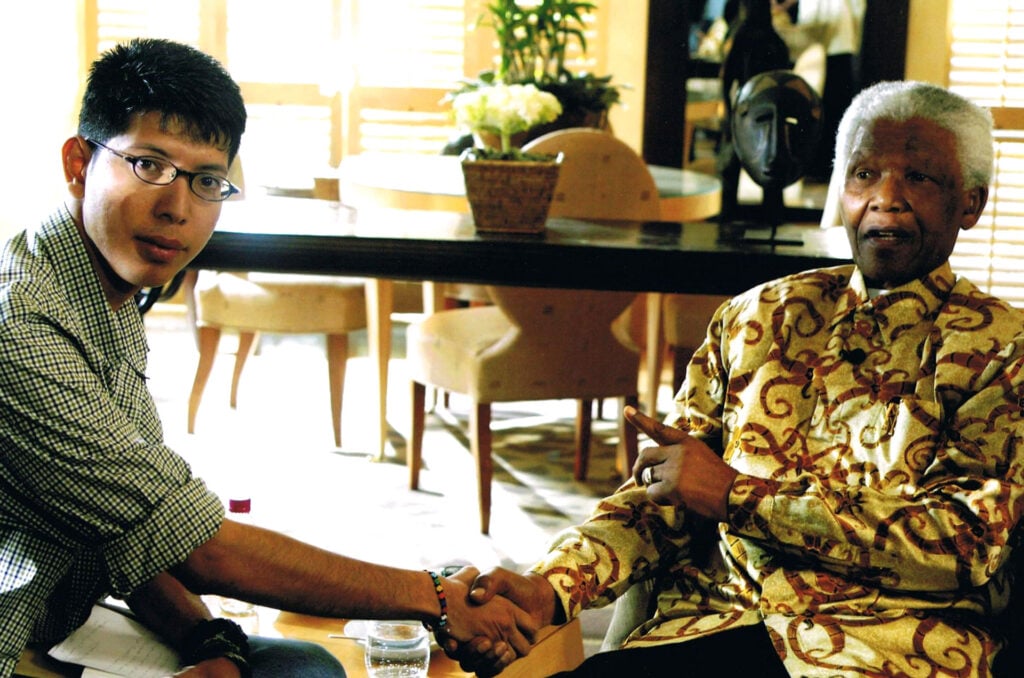
Photo: Min Zin with Nelson Mandela in Johannesburg, 2003
September 9 is the birthday of Min Zin, co-founder and Executive Director of the Institute for Strategy and Policy-Myanmar (ISP-Myanmar). Normally, on a day like this, Min Zin would be surrounded by warm wishes and heartfelt messages from those who love and respect him. This year, however, is different; he is currently in a place far removed from his family, colleagues and friends. On June 3, Min Zin was wrongfully detained by Chinese authorities while traveling to Kunming, China, to attend an academic seminar to which he had been invited.
On every birthday, Min Zin typically reflects back on his life’s journey and shares commemorative posts containing his deep thoughts on his social media. This year, we will not have the opportunity to read his new reflections. Spending his birthday silently in unseen darkness while being wrongfully detained is heartbreaking and deeply saddening for his family and friends.
On this “Min Zin’s birthday without him,” ISP-Myanmar would like to reshare the “Birthday Reflection” post written by Min Zin on September 9, 2022. By sharing this, we also remember and honor his intellectual guidance. We respectfully urge the Chinese authorities to facilitate Min Zin’s safe and prompt release. ISP-Myanmar hopes that he will be reunited with his family, colleagues, and friends in the near future.
Birthday Reflection
“I didn’t survive, I prepared.”
(Nelson Mandela)
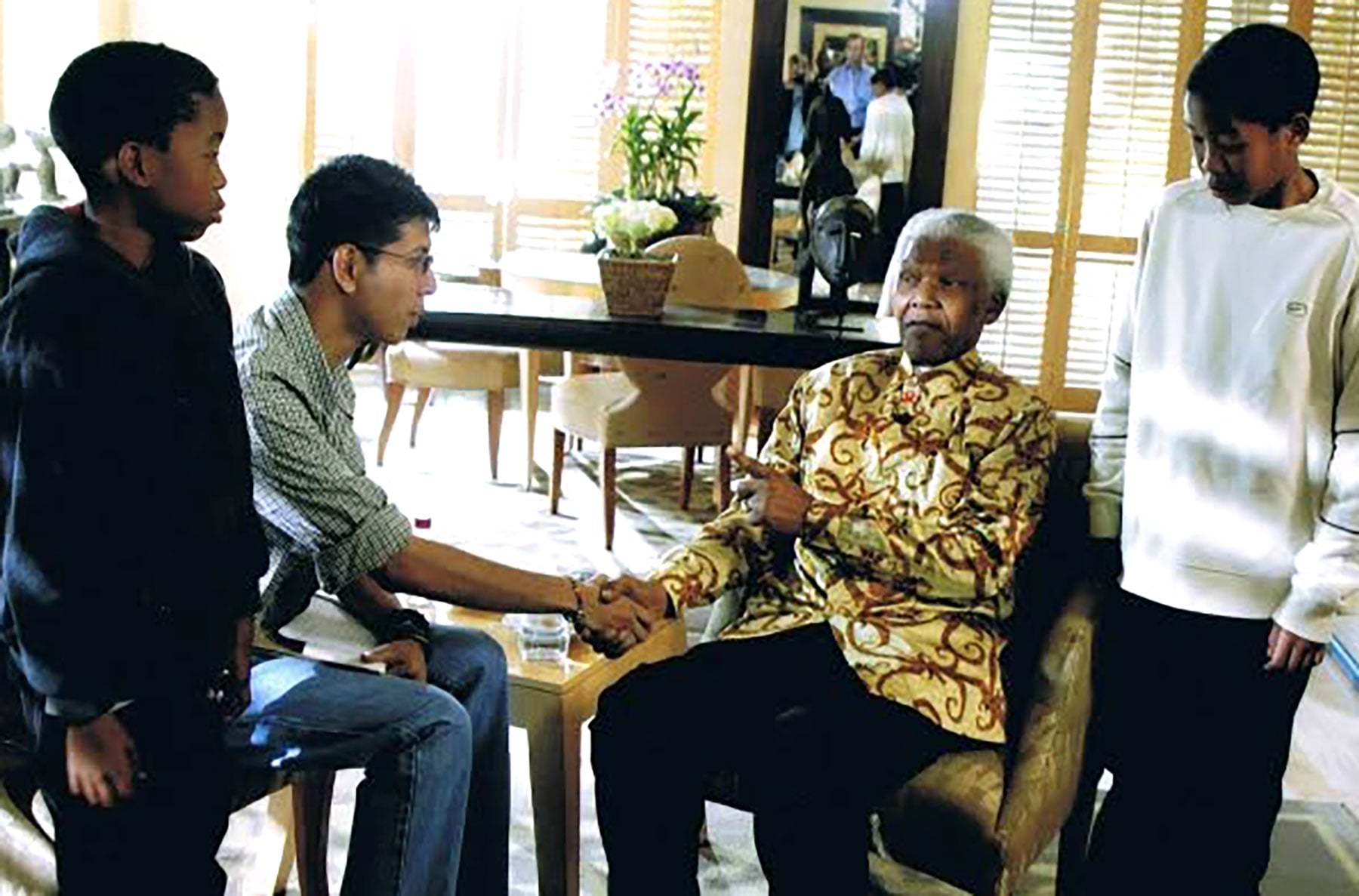
When Tony Robbins asked Mandela how he had managed to survive and stay alive in prison during those long years, Mandela looked at Tony intently and said, “I didn’t survive, I prepared.” I respectfully and dearly addressed Mandela as Madiba both on and off camera. I had a once-in-a-lifetime chance of speaking with him for over an hour, which I am very proud of. In particular, we compared and exchanged our respective experiences: his time in prison and my eight and a half years spent on the run within Myanmar to evade arrest by the military government. Our discussion did not turn into bitterness, but focused deeply and meaningfully on preparing to be ready and the transformation that comes with effort. Mandela’s words, “I didn’t survive, I prepared,” resonate directly and fittingly with my own life experiences of being on the run.
Later, when I co-founded ISP-Myanmar with my colleagues, we also operated with preparation in mind rather than just trying to survive. Although our work is directly related to politics, we were determined to build a think-tank that is independent and free from any party-political partisan bias. Because of this, we have faced storm-like attacks from all sides whenever they felt displeased with us at various times. Indeed, in complex and turbulent politics, the visibility of what lies ahead has often been blurry. However, we have had to steer our course as straight as possible, focusing on producing results. As Milton Friedman said, only a crisis — actual or perceived — produces real change. When a crisis occurs, and actions are taken to address it, people rely on the ideas and concepts that are available at that time. Therefore, the primary task of researchers must be to develop and cultivate new alternatives that differ from the status quo, existing rules, and policies; to keep them alive and active; and to keep them prepared so they can be readily available to be selected when needed. Things that seem politically impossible under current circumstances will eventually become politically inevitable (“the politically impossible becomes the politically inevitable”). When that time comes, the prepared alternatives and ideas will surely become the guides for action. At ISP-Myanmar, we have also learned from experience that during times of political deadlock, we should not just act haphazardly, but do what needs to be done for immediate matters (especially emergency and solidarity support) while purposefully preparing for an unavoidable political future.
I respectfully and dearly addressed Mandela as Madiba both on and off camera. I had a once-in-a-lifetime chance of speaking with him for over an hour, which I am very proud of. In particular, we compared and exchanged our respective experiences: his time in prison and my eight and a half years spent on the run within Myanmar to evade arrest by the military government. Our discussion did not turn into bitterness, but focused deeply and meaningfully on preparing to be ready and the transformation that comes with effort.
Indeed, this applies not only to life and politics. Since no one has an appointment with death, we must prepare for death as well. The teaching that “no one dies because they have free time” is a profound truth, as people often die while making excuses that they are too busy to prepare for death.
However, when preparing, we must not let pride take over by thinking our preparation is perfect (perfection). We must internalize that we can only prepare for gradual progress. In life, this is shaped by one’s virtues and circumstances (paramita in Buddhism); in politics, it is determined by human nature and preconditions. Otherwise, we will be possessed by arrogance and dogmatism, believing our perfection is superior and more correct. In this world, a true tragedy does not occur because evil triumphs over good; rather, the real heartbreak is when people, each firmly believing they are on the side of righteousness and that they alone are correct, clash, compete, and fight to defeat one another, causing immense human suffering and misfortune. Robert Kaplan often quotes Edith Hamilton, who remarked: “real tragedy is not the triumph of evil over good but the suffering caused by the triumph of one good over another.” In preparing for the future, we must embrace “Fallibilism”, the humble awareness that we, too, can be wrong.
In addition to adopting an attitude of preparing for progress rather than aiming for perfection with absolute pride, we must also internalize the truth that preparation does not guarantee success. While preparing is undeniably better than going through life unprepared, not every preparation yields success; thus, it is essential to acknowledge and accept the role of fate or fortune. When speaking of fate, those who worship worldly success like a religion, and those who passionately believe “nothing is impossible, it just hasn’t happened yet,” might turn up their noses. In this day and age, many view misfortune not as the turning wheel of fate (rising and falling), but as a result of bad or failed systems. Many believe that everything from famine, disease, and war to aging, sickness, and death happens because of systemic failures, falling through the cracks of a broken, unassured system. They offer prescriptions that fixing the system will make everything better. For myself, I always remind myself to prepare for life, country, and ultimately death, but to avoid capturing results with ego, believing that I can make myself perfect or that things must always turn out exactly as prepared.
As I get older, I understand the difference between wants (what I desire) and needs (what is necessary) better, and I try harder to manage and adjust my expectations. To incorporate and accept fate, even if you don’t have the time to (re)read the late Venerable Mahagandhayon Sayadaw’s “The Buddha’s Last Ten Months,” which concludes with “Anicca vata sankhara” (all conditioned things are impermanent), or “Consolation of Philosophy” by Boethius, a Stoic philosopher whose life ended in execution as he fell from high status to the worst of worldly conditions, let me share a song for you to listen to. It is one of the songs I have listened to almost constantly over the last couple of years. It is “You Can’t Always Get What You Want” by The Rolling Stones. It was written and sung with lyrics mainly focusing on love, politics, and drugs—the major obsessions of the 1960s. The chorus goes like this:
“You can’t always get what you want
You can’t always get what you want
You can’t always get what you want
But if you try sometimes, well, you might find
You get what you need
Ah, yeah
Oh”
I highly encourage you to listen to the original song here.
You can’t always get what you want. But if you try sometimes, you might just find you get what you need. I am passing this birthday reflecting on things with humility and a sense of spiritual urgency.
Min Zin
September 9, 2022
Thank you for allowing us to read this meditation, which allows us to connect with Min Zin in a way particularly meaningful today, as I read his wife’s testimony to the U.S. House of Representative of her hopes for his release. May her plea impact the future of Min Zin and us all.