
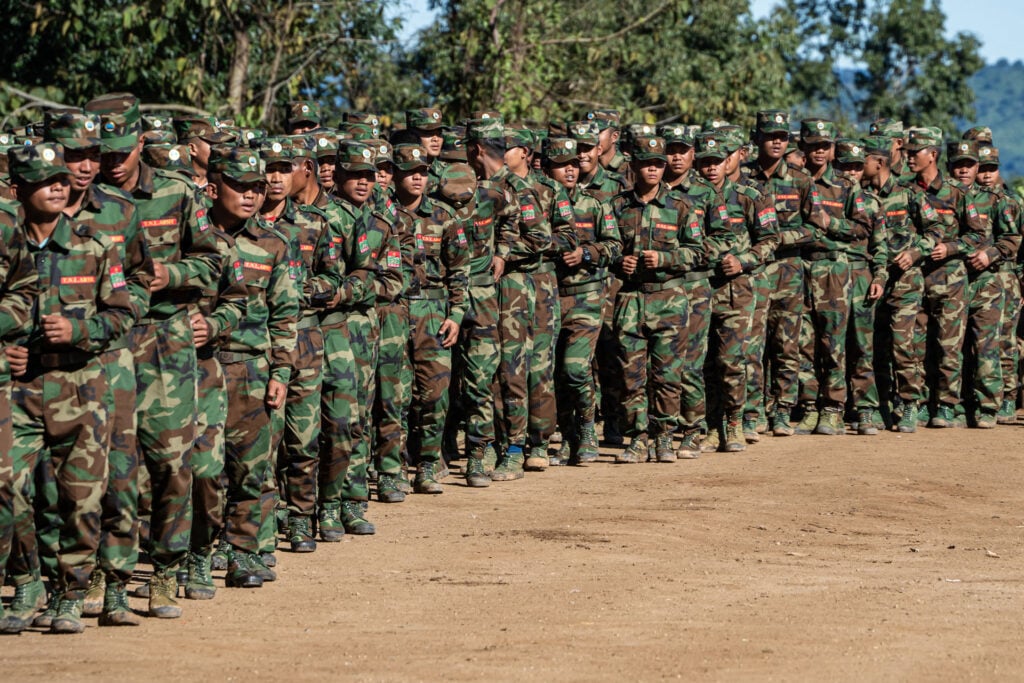
Photo – AFP
“Analysis of Conflict Economy – Northern Shan State” was published by the Institute for Strategy and Policy-Myanmar (ISP-Myanmar) on October 8, 2026, as an English translation of the original Burmese version released on September 7, 2026.This report covers the period from June 2025, to January 2026. This research is part of the ongoing research conducted by the ISP-Myanmar’s Political and Conflict Economy Studies.
Executive Summary
Following the 2021 coup, the conflict economy has expanded nationwide alongside armed conflict. As a pilot project, ISP-Myanmar studies the situation of the conflict economy in two areas of the country, in Karen State and northern Shan State, in order to analyze the feasibility of a hypothesis on Myanmar’s conflict. The situation can be assessed as a strategic stalemate has been reached at present; while the conflict may still be attritional skirmishes, neither side can achieve a decisive victory at the war level, meaning no one side can decisively win or lose. Therefore, this study analyzes whether actors will continue toward a zero-sum game, or whether economic incentives (or profit-sharing) can lead to conflict de-escalation and pave the way for political solutions. The situation in northern Shan State, however, differs from Karen State. In northern Shan State, China has pushed for a ceasefire between the Myanmar Armed Forces (MAF) and Ethnic Armed Organizations (EAOs), using considerable leverage to ensure stability along its border, and has introduced a program to reduce the conflict through economic incentives, trade, commerce, and investment.
The Myanmar National Democratic Alliance Army (MNDAA) and its allied forces control the majority of critical infrastructure for Myanmar-China trade in northern Shan State, including border gates, trade zones, and locations designated for the China-Myanmar Economic Corridor (CMEC) projects. EAOs continue to control the highest number of crucial road sections for the Myanmar-China border trade. The Muse 105-Mile Zone and the Kyinsankyawt border gate are locations where the profit-sharing interests of the EAOs align. Additionally, EAOs control mining sites that are economically vital, strategically important to China, and significant to global supply chains. The process of conflict de-escalation involving China is likely to shape the conflict landscape in northern Shan State. Preliminary agreements between the MNDAA and the MAF aimed to resume border trade and pointed to an emerging territorial partition driven by the mutual imperatives of border stability. A question arises; whether this is the neighbor China’s preferred model of Myanmar’s conflict resolution or conflict de-escalation model. Furthermore, a situation could emerge where the MAF holds leverage in its dealings with certain EAOs. Inter-ethnic conflict among the EAOs could also ignite in areas with contested territorial control, resource disputes, and geopolitical interests.
Analysis of Conflict Economy – Northern Shan State