
Photo – AFP
On July 25, 2026, ISP-Myanmar held its fifteenth 30 Minutes with the ISP event, titled “As Education Is a Sea, as Vast as Human Destiny!” This English translation of the event’s recap memo was published on August 17, 2026. The original Burmese version was published on August 11, 2026. This publication is part of research conducted under ISP Myanmar’s Socioeconomic Studies.
▪️Concept Note
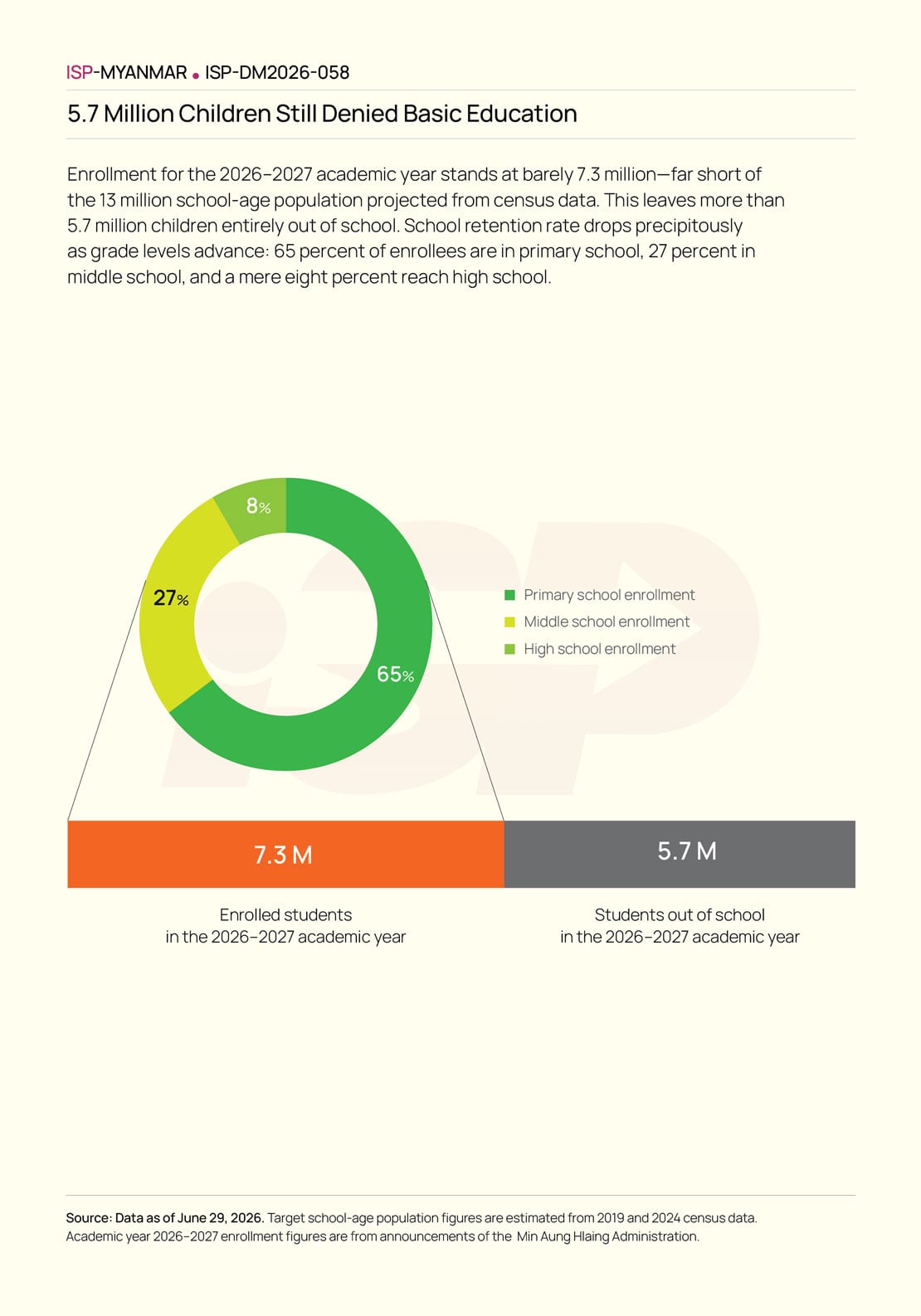
At the start of the 2026–2027 academic year, no fewer than 6.3 million children and youth in Myanmar have been forced out of classrooms, losing their right to basic education due to a confluence of factors, as ISP-Myanmar recently highlighted [See ISP Situation Brief (SB2026-01)]. Based on census figures, the school-age population eligible for basic education should stand at around 13 million. Meanwhile, barely six million remaining in school is a tragedy. Empty classrooms on this scale signal a generational crisis with profound implications for Myanmar’s social fabric. Though the alarm rings louder by the day, policy answers remain out of reach.
After the 2021 coup, education has moved to the forefront of political contestation within Myanmar’s armed conflict. Schools and educational systems operating under junta control have been fiercely denounced as indoctrination, while teachers, school grounds, and educational institutions have frequently come under attack. On the other hand junta airstrikes have repeatedly hit schools in resistance-held areas, resulting in heart-wrenching casualties among children. Ensuring a safe and peaceful educational environment requires resolving the broader political crisis paralyzing the sector. Physical safety is paramount; yet education must also be affordable, of acceptable quality, and critically, backed by recognized credentials and accreditation.
In traditional Myanmar thought, Pyin Nya (education/wisdom) is defined as the cultivation of critical thinking, discernment, and moral judgment. The educational philosopher Sir Ken Robinson highlighted two core objectives of education: first, to transmit a society’s shared values, beliefs, and culture to future generations; second, to equip students to thrive competitively in a rapidly changing world. In an era increasingly shaped by artificial intelligence, what kind of education can a conflict-ridden, unstable Myanmar pass on to its next generation? How will it equip children growing up in Myanmar today to face the demands of the 21st century?
Access to basic education in Myanmar was once a safe and predictable trajectory. No matter the hardship, basic literacy was a given, and primary schooling remained well within reach for the vast majority. Today, however, amid pervasive insecurity, anxiety, uncertainty, poverty, and political dysfunction, families are being forced to forfeit access not just to higher education, but to basic schooling itself. The crisis has deepened to the point where families have lost even the fundamental agency to choose where and what their children learn.
This tragedy echoes a classic verse from the poem Bodhi Shwe Kyaung—immortalized by Ywaza Sein Beda in Mingala Byaw Nyunt: ‘Which realm of wisdom will you master, my child, and for how many seasons will you pursueits depths?’ It is a question born of maternal hope and individual choice. Today, mothers are stripped of even the luxury to dream, let alone ask.
In this week’s session of 30 Minutes with the ISP (Episode 15), titled “As Education Is a Sea, as Vast as Human Destiny!”, we will explore how policy solutions can be forged to overcome Myanmar’s education access crisis. We cordially invite you to join the discussion.

Ko Khant
Event Host
ISP-Myanmar
Greetings to all Gabyin members attending today’s 30 Minutes with the ISP program. I am Ko Khant, and I will be your host for today’s session. Today’s program is the 15th discussion session of the 30 Minutes with the ISP series. The topic for today’s presentation is “As Education Is a Sea, as Vast as Human Destiny”
Leading today’s discussion are emerging researchers from ISP-Myanmar: Ko Chan and Amy. For today’s session, we have also invited an external expert, Saya Thein Naing. He is a dedicated policy researcher specializing in education and serves as an advisor on ethnic education.
Following the panelists’ discussion, we will address questions collected in advance from the Gabyin Community, as well as questions and comments from today’s attendees. You can submit questions and comments via the live stream, or through the Chat and Q&A features. Due to time constraints, if we are unable to answer all questions during the live session, we will respond via email later.
Please note that questions and comments must be respectful and must not contain hate speech or derogatory remarks regarding race, religion, gender identity, or differing political views. These guidelines have also been shared in the chat. Today’s program is being broadcast live on the DVB TV news channel as well as on ISP-Myanmar’s website and social media platforms.
We will now begin our discussion. Ko Chan, the floor is yours.

Ko Chan
Panelist
ISP-Myanmar
Thank you, Ko Khant. Currently in Myanmar’s education sector, children are outside the classroom, and teachers are outside the formal system. One out of every two children is unable to access education. This is a profoundly alarming situation for our country’s future.
When we look at the state of education following the coup, we have encountered severe adversity. In particular, education has become a battleground for political legitimacy. Classrooms and schools increasingly resemble active conflict zones and targets. However, a country’s future is not determined on the battlefield; it is shaped within the classroom. Therefore, we must view this education crisis through the lens of a broader political crisis and actively seek policy solutions. Today’s discussion represents our attempt to explore these policy solutions.
We will divide today’s discussion into three parts. First, we will examine the root causes of the current education crisis. Second, we will discuss the associated impacts and consequences—what we are currently observing and what we may face later. Finally, in the third part, we will focus on policy solutions – practical steps that can be implemented. Let us begin with the first part: the underlying root causes of the education crisis. Amy, please go ahead.

Amy
Panelist
ISP-Myanmar
Thank you, Ko Chan. As a young researcher studying education, I would like to share my findings and observations today. To address Ko Chan’s question regarding the root causes of the current education crisis, I would like to discuss them in three points: safety, affordability, and the decline in educational quality.
These three root factors prevent many children from returning to school. First is the issue of safety and security. As we all know, the current environment lacks the fundamental safety required for learning. Data clearly illustrates this reality: between 2023 and 2024 alone, there were 217 recorded attacks on schools. That is a significant figure. Furthermore, schools were referred to as military targets on roughly 141 occasions. These figures highlight that educational spaces are no longer safe.
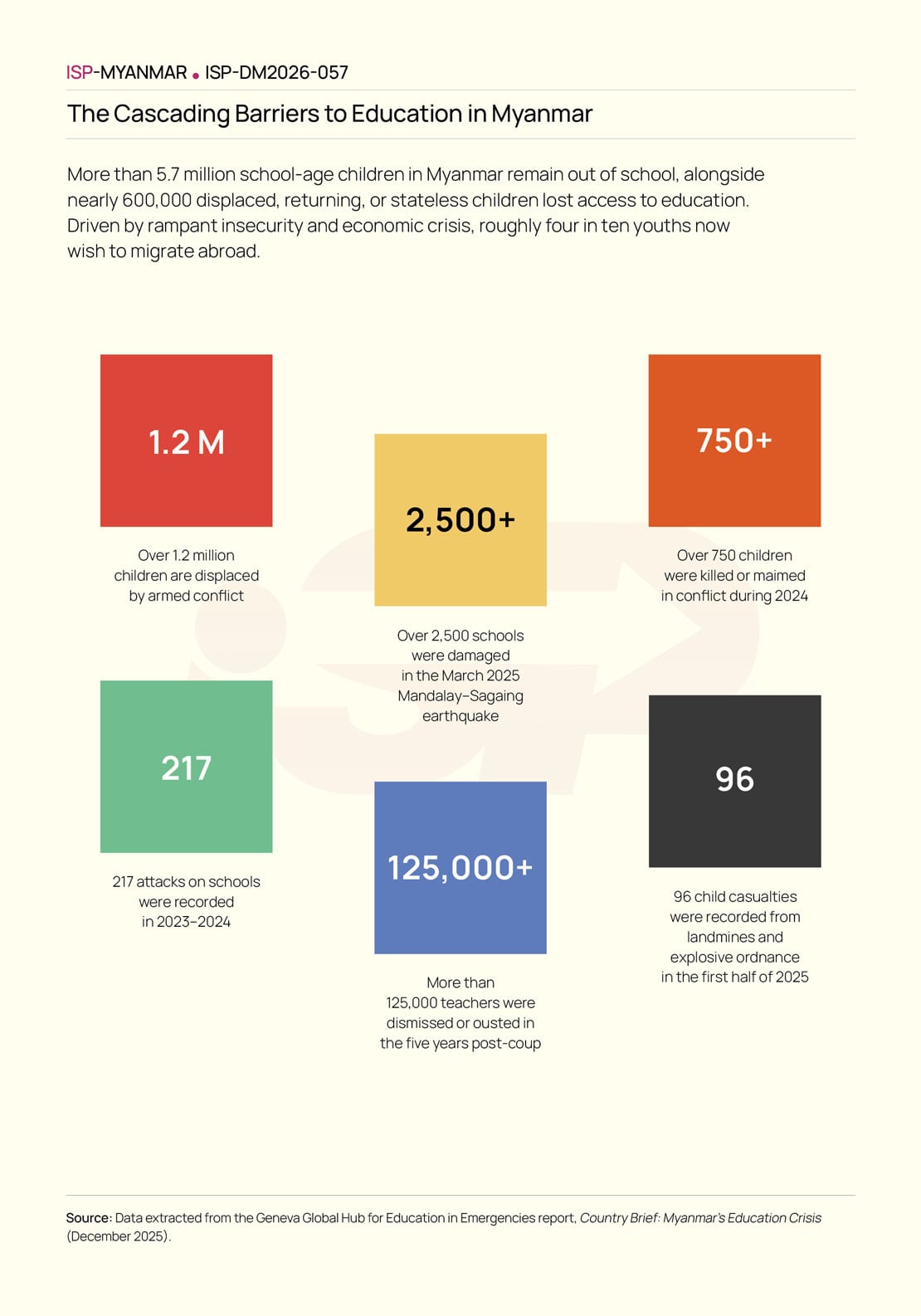
As Ko Chan noted, education requires safety for both educators and learners. Looking at the security of teachers, over 500 teachers have been arrested and detained to date, and at least 37 teachers have been killed. This demonstrates the severe lack of safety faced by educators.
Children face similar peril. According to figures in 2024, over 750 children have lost their lives or suffered limb amputations as a direct result of the conflict. Among these 750 children, at least 240 suffered premature death or disability due to landmines and explosive remnants of war (ERW). These metrics clearly underscore the total absence of security for both students and teachers.
The second factor is affordability. Currently, over six million students are unable to attend school due to various reasons. This figure accounts for just a single academic year; across the five years since the coup, the cumulative number is likely far higher. Beyond physical insecurity, this reflects the financial inability of grassroots families to afford basic education. Even where “free education” is nominally offered, ancillary annual expenses—such as paperwork, stationery, and textbooks—have become financially prohibitive. As a result, many children drop out to seek employment rather than continuing their education. This reflects the severe barrier of affordability and accessibility in education today.
The third factor is the decline in quality of education. I would divide this issue into two aspects. Educational quality was already a sector with pre-existing structural shortcomings, where efforts were underway to reform pedagogical approaches. However, during the post-coup period, the opportunity to sustain these educational improvements diminished drastically, further deteriorating education quality.
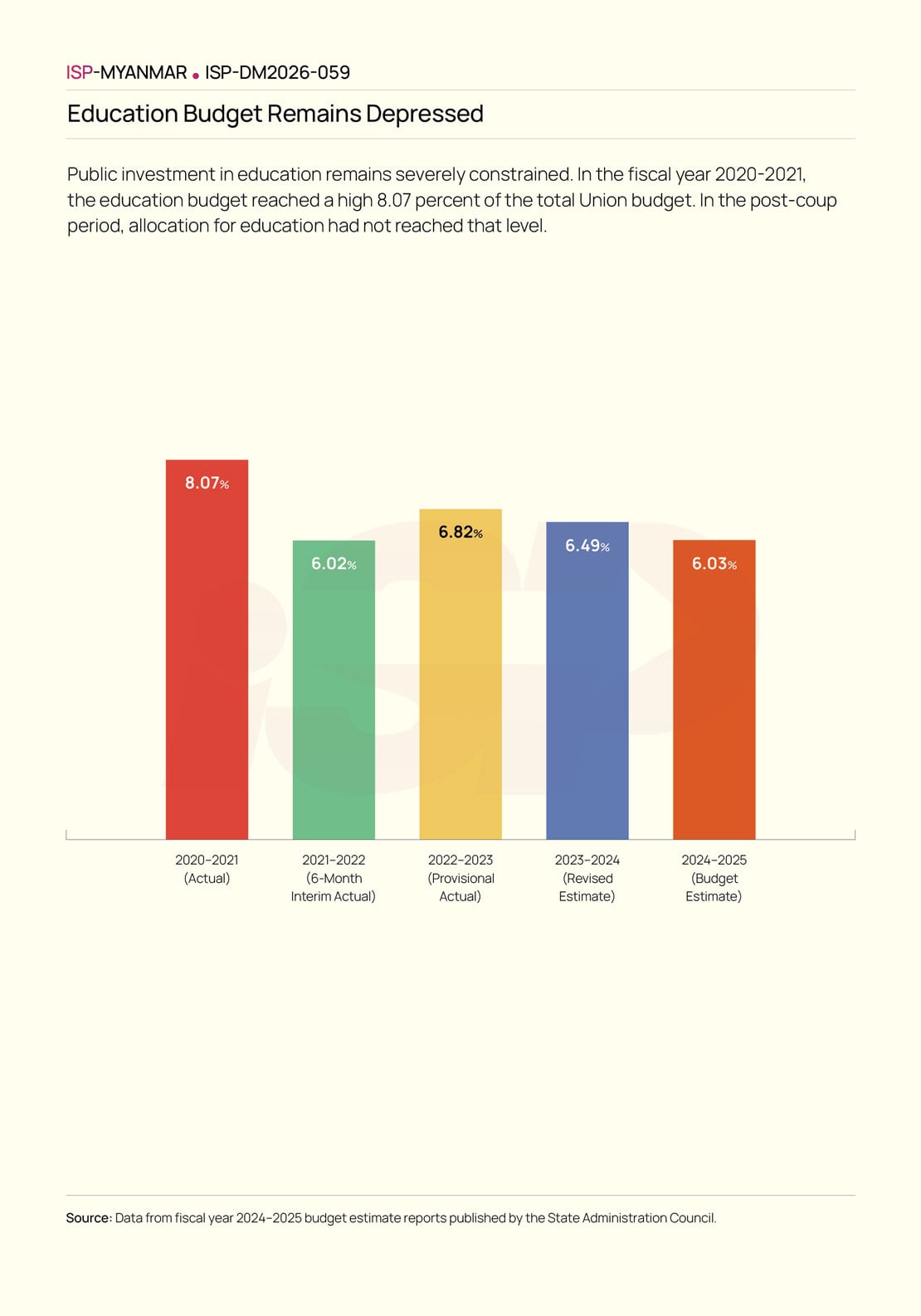
I would like to discuss the causes of that decline, beginning with budget constraints. Union-level budget allocations for education have dropped significantly. In Fiscal Year 2020–2021, education accounted for over 8 percent of total Union expenditure. By FY2024–2025, that proportion has declined substantially. Although it is projected to rise slightly to 6.92 percent in the upcoming fiscal period, it remains well below pre-coup levels. This underscores the deficit in educational funding.
Second, reduced funding is compounded by a loss of instructional capacity. The gap left by teachers participating in the Civil Disobedience Movement (CDM) remains immense. In attempts to fill these vacancies, quantity has frequently been prioritized over quality. Conversely, while community-led education systems have been established in liberated areas with support from CDM teachers, resources there remain far from adequate. Consequently, neither side possesses the necessary quality or capacity to maintain educational standards.
In summary, these three core factors—safety, affordability, and declining quality—form the bedrock of the present education crisis. I invite Ko Chan to elaborate on the remaining factors.
Ko Chan
Panelist
ISP-Myanmar
Yes, Amy outlined three primary reasons why students are missing from classrooms. In addition to these, I would like to highlight two further critical and urgent factors that require immediate attention.
The first is the issue of accreditation and recognition, which is intrinsically tied to system existence and institutional coordination. Due to the ongoing political and armed conflict, educational credentials are not mutually recognized across different systems. As a result, students face immense ambiguity and uncertainty regarding their futures in pursuing tertiary education. They are left wondering if they can continue their studies at all. Therefore, establishing frameworks for accreditation and recognition is an urgent priority. While some efforts exist, widespread implementation remains lacking.
Directly related to accreditation is the linkage between systems. Recognition can only function smoothly when structured education systems exist and actively coordinate with one another. Without functioning systems and cross-system cooperation—for instance, if a student from Mai Ja Yang wants to enroll at Myitkyina University, or a student from Rakhine State seeks to attend a college in Shan State—transitions become exceedingly difficult. Thus, we must address institutional recognition, formal system building, and cross-system linkage simultaneously to facilitate student mobility across regions and administrative jurisdictions.
Addressing these root causes is crucial if we are to resolve the present crisis. Otherwise, the future of our nation and our children remains deeply concerning.
That concludes our discussion on the root causes. Moving to the second part, Amy will now discuss the related impacts and consequences in both the short and long-term.
Amy
Panelist
ISP-Myanmar
The impacts of the education crisis are critical for the whole nation. As Ko Chan noted, these consequences demand urgent policy solutions. I would divide these impacts into two primary dimensions.
First, let us revisit the core definition of education. Wisdom (Pyin Nya) has traditionally meant the reasoning and discernment to critically distinguish between right and wrong. When learning spaces become severely constrained or inaccessible, society loses this fundamental discernment—representing the single greatest loss among all impacts.
Directly tied to this is the loss of skilled labor and human capital. Myanmar urgently requires expertise across numerous sectors. Without qualified professionals and an educated populace, the nation’s future drops to a critically alarming point.
The second major impact is the exacerbation of “brain drain” under successive military regimes. Today, brain drain has intensified to unprecedented levels. We are witnessing a massive exodus not only of educated professionals but also of youth with incomplete educations. This represents the most acute aspect of human capital flight.
On a practical social level, schools traditionally served as a “second home” where youth learned sociocultural norms alongside academic subjects. With school access severely restricted, these foundational societal norms are increasingly ignored.
We can observe this breakdown in student behavior and school affairs today. Where schools once instilled empathy, mutual respect, cooperation, and social ethics, the absence of this social education has led to severe real-world fallout. We now frequently see youth engaging in armed fights, incidents causing severe bodily harm or death, public intoxication, and overt narcotic abuse within local communities. These are no longer isolated social media reports; they are visible daily in our immediate surroundings. These represent the direct, tragic consequences of the ongoing education crisis. We just discussed the impacts of the education crisis in two parts.
Ko Khant
Event Host
ISP-Myanmar
Thank you to our panelists. Next, our guest expert, Saya Thein Naing, will discuss practical steps to address this education crisis. Saya, We would like to invite you to share your perspective on the following question: In the current political and conflict landscape, what practical policy measures should decision-makers implement to alleviate this education crisis? The floor is yours, Saya.

Saya Thein Naing
Guest Expert &
Education Policy Researcher
Thank you for inviting me. The crisis in education is immense. Whether caused directly by the collapse of education or the broader political landscape, we cannot ignore the reality that Myanmar is drifting toward a failed state. Nearly half of our student population is disconnected, displaced, or deprived of basic education. The severe decline in educational quality and physical security clearly indicates that our country is on the path to becoming a failed state.
Addressing education requires extraordinary effort. Amidst political conflict, those striving for access to education and quality education are making truly strenuous efforts. We cannot simply wait for a political resolution before acting on education; doing so would be deeply cruel to our children and youth. Learning must not be halted while political divisions exist—whether two, three, or four opposing factions.
I would like to present three priority policy measures that education communities, organizations, and policymakers should consider. My recommendations focus heavily on conflict-affected regions bearing the brunt of the civil war, though they offer actionable insights for both sides of the conflict. Threatening education harms all stakeholders, regardless of political alignment. In particular, targeted airstrikes represent the single greatest danger to education today. To protect education through policy, I propose the following three points.
It is imperative that school environments in ethnic-controlled regions, rural areas from dry zones, and educational areas be designated as strict safe zones. The practice of targeting schools and educational spaces is an appalling stain on our nation’s future. Reciprocal attacks and retaliatory strikes on learning spaces inflict severe harm on both sides.
All stakeholders must establish and uphold comprehensive safety measures for educational spaces and social well-being. Protecting children’s right to learn, upholding human dignity, and guaranteeing survival must be prioritized above all else. Military and security personnel must refrain from interfering in educational affairs, classrooms, or school administration, and instead honor the leadership of local education bodies and community will. Security forces should assist in protecting learning spaces.
Furthermore, physical safety measures are urgently needed in educational zones. During the rainy season, many students and teachers are forced to learn in makeshift conditions—under leaky shelters, inside caves, along deep ravines, or in hazardous conflict zones. Regional administrative units must implement concrete safety policies to relieve them from these conditions. Even if authorities on opposing sides cannot actively assist these community schools, they must at least cease military attacks to prevent further tragedy.
The second point is to prioritize teacher quality, curriculum development, and education funding. Compounding the issue of empty classrooms is the growing exhaustion and demoralization among teachers, leading to unprecedented dropout rates across urban and rural areas alike. The entire education system risks complete paralysis or extreme quality degradation.
We must implement innovative mechanisms to improve teachers’ professional capacity and socioeconomic livelihoods, especially in areas implementing community-based education. Urgent measures are needed to guarantee teachers’ life safety, financial sustainability, and professional dignity. We must stem the alarming rate of teacher dropouts by providing scholarships, professional development pathways, and capacity-building opportunities. Additionally, we must invest in cultivating educators capable of delivering competency-based education and executing Mother-Tongue-Based Multilingual Education (MTB-MLE).
Third, opposing political factions have expressed commitments to building a federal union. Here, it is essential that a Federal Democratic Education System be actively implemented across regions. Formally recognizing federal unit-based, community-based, and ethnic-based education systems will significantly alleviate both quantity and quality deficits. In the long run, decentralized education management will also contribute directly to resolving broader political conflicts.
During this interim period, we must advance a federal democratic education model to support the political vision of a federal state, making a consolidating effort through education. We need to provide decision-making autonomy for local education bodies. Federal states and regional units must adopt, nurture, and implement Mother-Tongue-Based Multilingual Education (MTB-MLE) policies in schools.
Centralized control over education remains widespread and must yield to local decision-making autonomy. At the same time, we also need to nurture a structured local education system. Curriculum diversity should not be viewed as an obstacle. However, to facilitate student transfers across state lines and institutional transitions—as Ko Chan highlighted—we must establish common educational standards. This would also become a policy initiative for Federal Democratic Education. We can draft standards and policy in line with the Federalism. We need to build education dialogues to discuss common curriculum frameworks, a common policy platform, and overall conditions of diverse areas. We also need to collect education data systematically during this transitional period.
In summary, protecting every child and teacher requires robust safety policies supported by local governance and defense forces, without any disturbance by any stakeholder. We must cultivate education policies in line with federal democracy and safeguard the dignity and livelihoods of our educators. These three pillars offer a practical pathway forward for the nation’s future and eventual post-conflict national rehabilitation. Thank you.
Ko Khant
Event Host
ISP-Myanmar
Thank you very much, Saya Thein Naing, for your insightful contributions. That concludes our primary presentations. Due to time constraints, we would like to skip the live Q&A session here. Attendees with remaining questions are invited to submit them via email to ISP-Myanmar, and we will follow up later. I now invite our panelists to share their concluding remarks.
Ko Chan
Panelist
ISP-Myanmar
Thank you, Ko Khant. To summarize today’s discussion, we examined the five underlying root causes of the present education crisis, their immediate and long-term societal impacts, and practical policy solutions, which are contributed by Saya Thein Naing.
To conclude, I would like to highlight a point made by Saya Thein Naing and emphasize three actionable policy recommendations that can be initiated immediately. I agree with what Saya Thein Naing mentioned: the education crisis must not wait for a complete political resolution. We must recognize that the education crisis is fundamentally a political crisis and take proactive steps to address it. This is the point from Saya Thein Naing’s discussion I would like to highlight. Now I would like to emphasize three actionable points.
First, we need to strengthen community-based support structures. Historically, local affluents and religious leaders played a vital role in sustaining education. We need to sustain such practice for the current crisis as well. At the same time, we need to formalize these efforts into structured, sustainable systems to build long-term resilience for education.
Secondly, education must be explicitly placed on the agenda of political and peace negotiations. Beyond discussion, political actors must collaborate to formulate immediate, short-term practical solutions.
Concurrently and thirdly, we must seek international assistance to strengthen domestic educational capacity, support students, and create international scholarship pathways for Myanmar youth.
With these three priority recommendations, I would like to conclude today’s session.
Ko Khant
Event Host
ISP-Myanmar
Thank you, Ko Chan, for the concluding summary. Research data from today’s discussion and other ISP-Myanmar findings are available free of charge on our website at www.ispmyanmar.com and across our social media platforms.
I would like to express my sincere gratitude to every member of the Gabyin Community who took the time to join us today. With that, we conclude today’s session.