
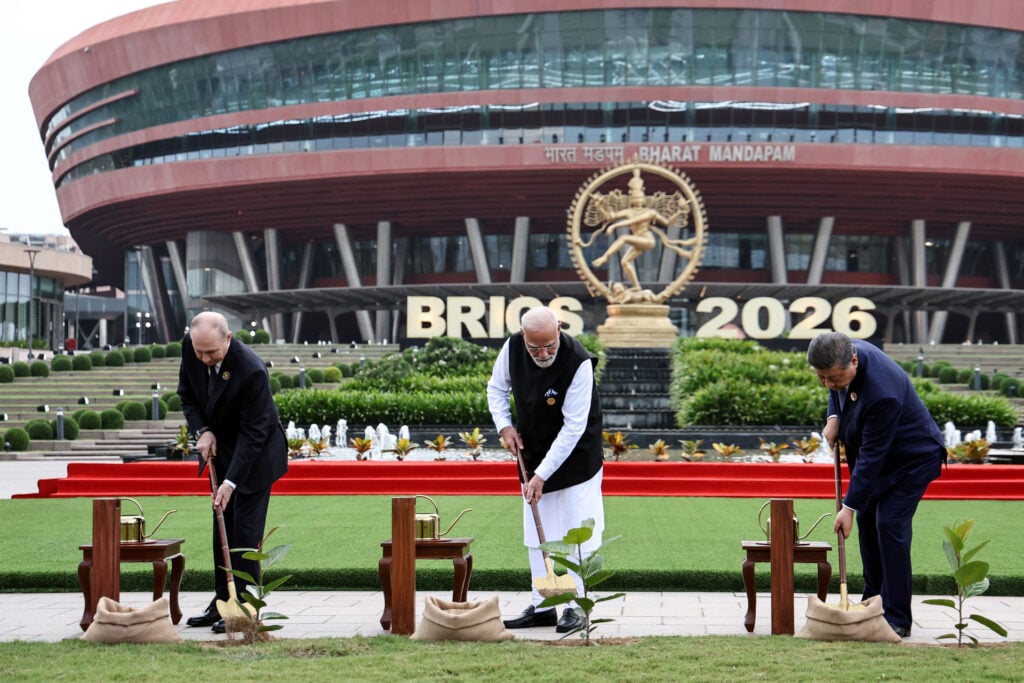
Photo – AFP
[The views and opinions expressed here do not necessarily reflect the policies or positions of ISP-Myanmar. Readers wishing to share reflections or offer counterarguments are welcome to write and submit a rebuttal article.]
The 18th edition of the BRICS Summit concluded in New Delhi on September 13, with the Chinese President Xi Jinping pushing for a “Greater BRICS” to further amplify the Global South’s voice1. In fact, over 30 nations are vying for entry into this influential economic and geopolitical bloc, representing 49.5 percent of the global population, 40 percent of global GDP, and 26 percent of global trade2. Despite severe domestic instability from fratricidal conflict, Myanmar’s quest for BRICS membership is logical, as it aims to leverage the opportunities this platform offers to promote holistic economic growth. “We are interested in joining BRICS. Through BRICS, through our cooperation, we intend to achieve new sources of financing for technology,” Myanmar’s Minister for Investment and Foreign Economic Relations Kan Zaw had asserted in 2025 at the plenary session of the 10th Eastern Economic Forum in Russia’s Vladivostok3. Besides, Min Aung Hlaing’s visit to Russia in August this year, following his successful trips to India and China, is expected to boost Naypyitaw’s BRICS membership bid. After all, President Vladimir Putin’s expression of gratitude to Myanmar for the country’s assistance in promoting Russia’s relations with ASEAN (the Association of Southeast Asian Nations) carries a transactional undertone4.
In fact, the regime in Naypyitaw has been consistently pushing Russia for support in its effort to have a seat at the BRICS high table, which will enable the pariah country to secure crucial funding for stabilizing the economy ruined by sustained ethnic conflict. Myanmar is desperately trying to cling to the opportunity for development beyond Western-dominated institutions that BRICS provide. So much so that the former Information Minister Maung Maung Ohn – while attending the 2024 BRICS Media Summit in Moscow – even expressed his country’s willingness to be an observer in BRICS if full membership was not available immediately5. Meanwhile, to prop up one of Southeast Asia’s most troubled nations’ flagging economy, Russia’s ally and neighbor Belarus is also doing its bit to fructify Myanmar’s BRICS-entry dream after joining the grouping as a partner in 20246.
Accordingly, Myanmar is expecting India’s consent in its endeavor to obtain BRICS membership. Completely isolated from the West, Naypyitaw has heavily relied on China’s diplomatic clout to gain immunity in multilateral fora and preserve economic continuity. On this point, India is faced with a complex strategic dilemma regarding Myanmar’s bid for BRICS membership, and finding a middle ground is not that easy.
Being the Chair of the 18th BRICS Summit, India underscored the importance of inclusiveness in global governance. On its 20th anniversary, the BRICS alliance projected itself as a distinct voice on the global stage, with a consensus-based approach that allowed members with diverse perspectives to work together. “Today, BRICS too stands at a ‘coming of age’ moment. Over the past twenty years, BRICS has established a distinct identity for itself on the global stage. We respect each other’s perspectives and move forward through consensus. We strive to move ahead with an approach that is not against anyone but instead seeks to take everyone along,” said Indian Prime Minister Narendra Modi in his address to the august gathering7. Accordingly, Myanmar is expecting India’s consent in its endeavor to obtain BRICS membership. Completely isolated from the West, Naypyitaw has heavily relied on China’s diplomatic clout to gain immunity in multilateral fora and preserve economic continuity. On this point, India is faced with a complex strategic dilemma regarding Myanmar’s bid for BRICS membership, and finding a middle ground is not that easy. Despite BRICS’ growing appeal and influence in the developing world, New Delhi’s vision of BRICS revolves around strategic pluralism – of building a complementary parallel order, sensitive to the developing world’s needs, and not resisting the West per se.
Indian policymakers are privately wary of the BRICS turning into a juggernaut that will isolate India and undermine its partners in the Indo-Pacific. It is an undeniable reality that the disparity in power between China and the rest of the BRICS members is too big to bridge in the short or medium term – they argue. However, the fact is, opposing Myanmar’s inclusion will push Naypyitaw further into China’s economic and strategic orbit. That will be a disaster for India because critical cross-border projects, on which New Delhi has already invested, require a stable working relationship with the regime as well as the ethnic resistance forces wielding physical control over territories along the country’s eastern and northeastern frontier. True, India’s official endorsement of Myanmar’s BRICS entry will amount to legitimizing a government which lacks formal global recognition. Besides, a fragile and volatile Myanmar will add to the geopolitical friction that BRICS is already enduring, which might affect the bloc’s long-term stability too. But, on the flip side, access to a new multipolar ecosystem that comes with alternative financing prospects and a geopolitical framework of greater strategic value will make Myanmar less China-dependent. Historically, Myanmar’s proclivity for non-alignment is rooted in its intense dislike of any form of foreign pressure or interference, which has triggered the strategic pivot towards BRICS’ structural model of non-interfering multipolarity based on the concept of sovereign equality and non-interference.
Seema Sengupta is a Kolkata-based journalist and columnist.
Citations:
- https://www.forth.news/stories/Cf44tX1CG91yetUeEJfNr ↩︎
- https://www.pib.gov.in/PressNoteDetails.aspx?id=159946&NoteId=159946&ModuleId=3®=48&lang=2 ↩︎
- https://tvbrics.com/en/news/myanmar-interested-in-joining-brics/ ↩︎
- http://en.kremlin.ru/events/president/transcripts/80557 ↩︎
- https://tass.com/world/1843357/amp ↩︎
- https://www.belarus.by/en/government/events/fm-belarus-will-support-myanmars-engagement-with-international-organizations_i_0000199140.html ↩︎
- https://www.pib.gov.in/PressReleasePage.aspx?PRID=2309468®=48&lang ↩︎