

Photo – AFP
On September 19, 2026, ISP-Myanmar held its seventeenth 30 Minutes with the ISP event, titled “Dawei, Yadanabon, and Myitsone – Questions for Myanmar’s Development Dreams.” This English translation of the event’s recap memo was published on October 9, 2026. The original Burmese version was published on October 9, 2026.
Concept Note
The Min Aung Hlaing administration is attempting to revive several long-stalled foreign investment projects. Primary examples include the Dawei Special Economic Zone (SEZ) in the far south, Yadanabon Cyber City in the central region, and the Myitsone Dam project in the north. The Min Aung Hlaing administration frames these megaprojects as driver for employment, energy, and national development. It approaches development as a transactional affair, assuming that allocating land and securing capital will automatically yield ports, dams, and modern urban centres and, in turn, generate economic growth.
However, development cannot be reduced to a mechanical formula where inputs like land and capital automatically produce developmental outputs. True development comes from an interconnected ecosystem. Achieving this requires robust property rights, functioning institutions, skilled labor, reliable power and communications infrastructure, and accessible financial credit. Globally, large-scale industrial zones and infrastructure projects are often leveraged as instruments for industrialization and economic transformation. While inherently high-risk and high-reward, these projects can yield genuine development only when backed by stability, economic openness, and political legitimacy—elements that foster long-term commitment from both investors and local communities. Megaprojects do not create an ecosystem; rather, they depend on one. Without a functional ecosystem, even completed projects fail to deliver shared prosperity. Instead, they risk becoming isolated enclaves that enrich only the rulers and well-connected elites.
Examined through this lens, efforts to revive these megaprojects raise serious questions. The Myitsone Dam project lacks public consent and suffers from weak foundational infrastructure and distribution systems. Yadanabon Cyber City, dubbed “Myanmar’s Silicon Valley,” remains far easier said than done, lacking vital components such as reliable electricity, digital infrastructure, legal protections, and a skilled workforce. Meanwhile, the Dawei SEZ project faces severe financial hurdles alongside ongoing armed conflict. Compounding these project-specific challenges, Myanmar’s macroeconomic foundations—including foreign exchange reserves, currency exchange mechanisms, investor confidence, power supply, and land governance—remain in total disarray.
In this episode of “30 Minutes with the ISP,” our young researchers analyze the background and current status of the megaprojects pursued by the Min Aung Hlaing administration, evaluating whether these initiatives can lead to genuine development.

Linn Htet
Event Host
ISP-Myanmar
Warm greetings to all Gabyin community members attending today’s “30 Minutes with the ISP” program. I am Linn Htet, and I will be serving as the MC for today’s event. Today, we will be discussing the topic “Dawei, Yadanabon, and Myitsone – Questions for Myanmar’s Development Dreams.” Today’s discussion will be led by ISP-Myanmar’s emerging researchers: Ko Chan, Kaung San, and Mary. Following their presentations, we will address questions asked in advance by members of the Gabyin community, as well as live questions and comments from today’s attendees. If we cannot address all questions during the event due to time constraints, we will respond via email. Please keep in mind that questions and comments must not contain hate speech, insults, or derogatory remarks regarding race, religion, gender, sexual orientation, or differing political views. We have also posted these guidelines in the chat.
Today’s session is being broadcast live on the DVB TV News and ISP-Myanmar Facebook pages. Let’s get the discussion started. Ko Chan, the floor is yours.

Ko Chan
Panelist
ISP-Myanmar
Hello, and greetings to all Gabyin community members. Thank you all for attending today’s discussion. Today, we want to discuss how Min Aung Hlaing is attempting to revive stalled megaprojects. Following the coup, foreign direct investment in our country plummeted. If we compare the five years prior to the coup with the post-coup period, investment volume dropped by 74 percent. To attract back investment, the megaprojects are framed as driving forces for national development that generate employment, produce energy, and so forth.
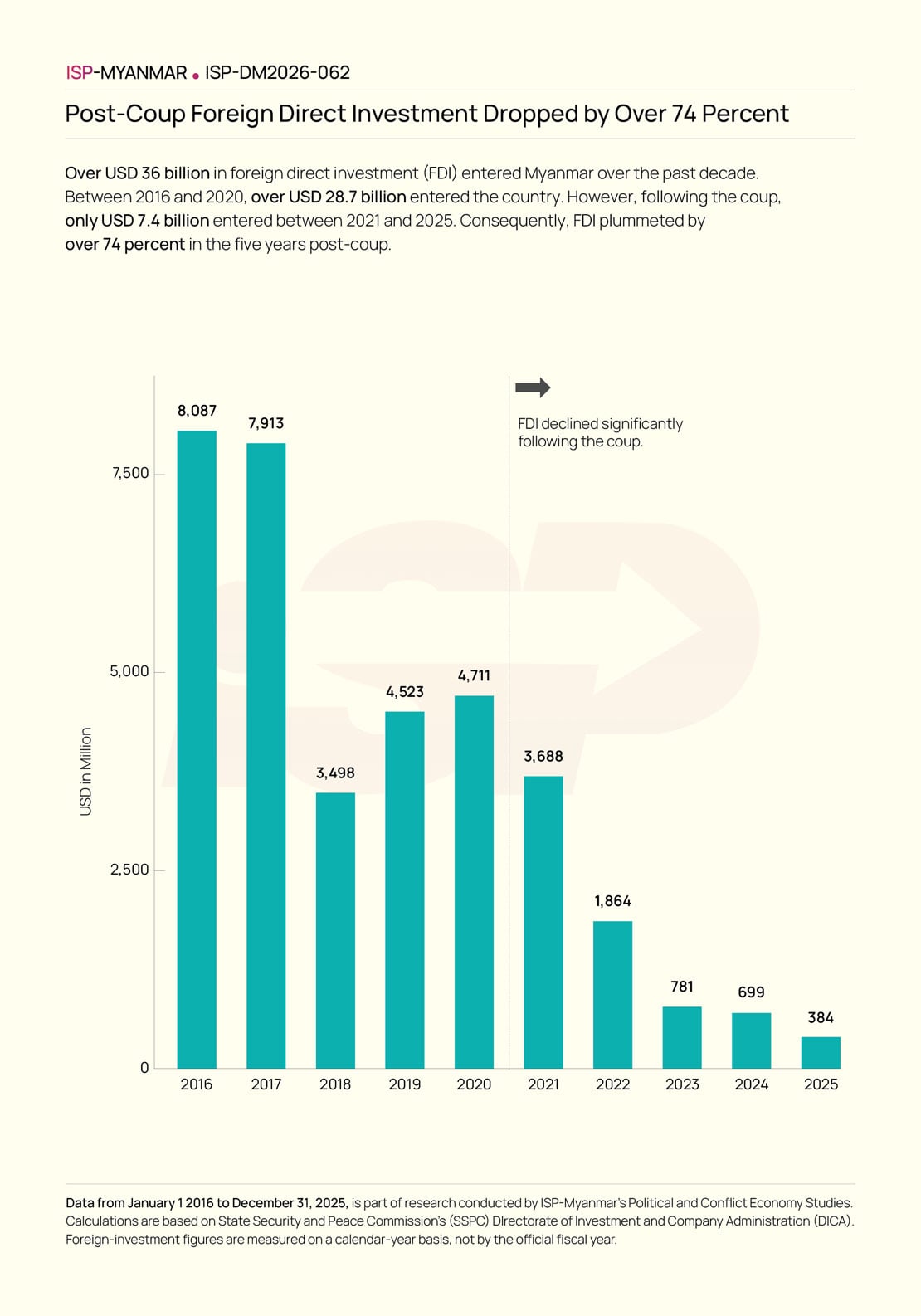
However, whether these projects will truly bring development is something we need to analyze. Here, we can’t ignore the ongoing nationwide conflict. Furthermore, unlike during the pre-coup transition period, we lack the foundational groundwork, and public support is completely absent. Consequently, both domestic and international legal frameworks to regulate investment projects remain weak. It is therefore questionable whether current efforts will achieve any tangible success.
Additionally, the approach to development seems to be simply treated as a transactional equation. For instance, offering land, inviting capital, starting construction, generating output, and assuming that long-term development will seamlessly follow. However, when we speak of real development, we need to examine three dimensions: Is the political dimension stable? Is the economic dimension reliable? Is the social dimension equitable and inclusive, and are there policy measures to ensure this balance? These dimensions must be harmonized. We plan to question and discuss these perspectives under current conditions.
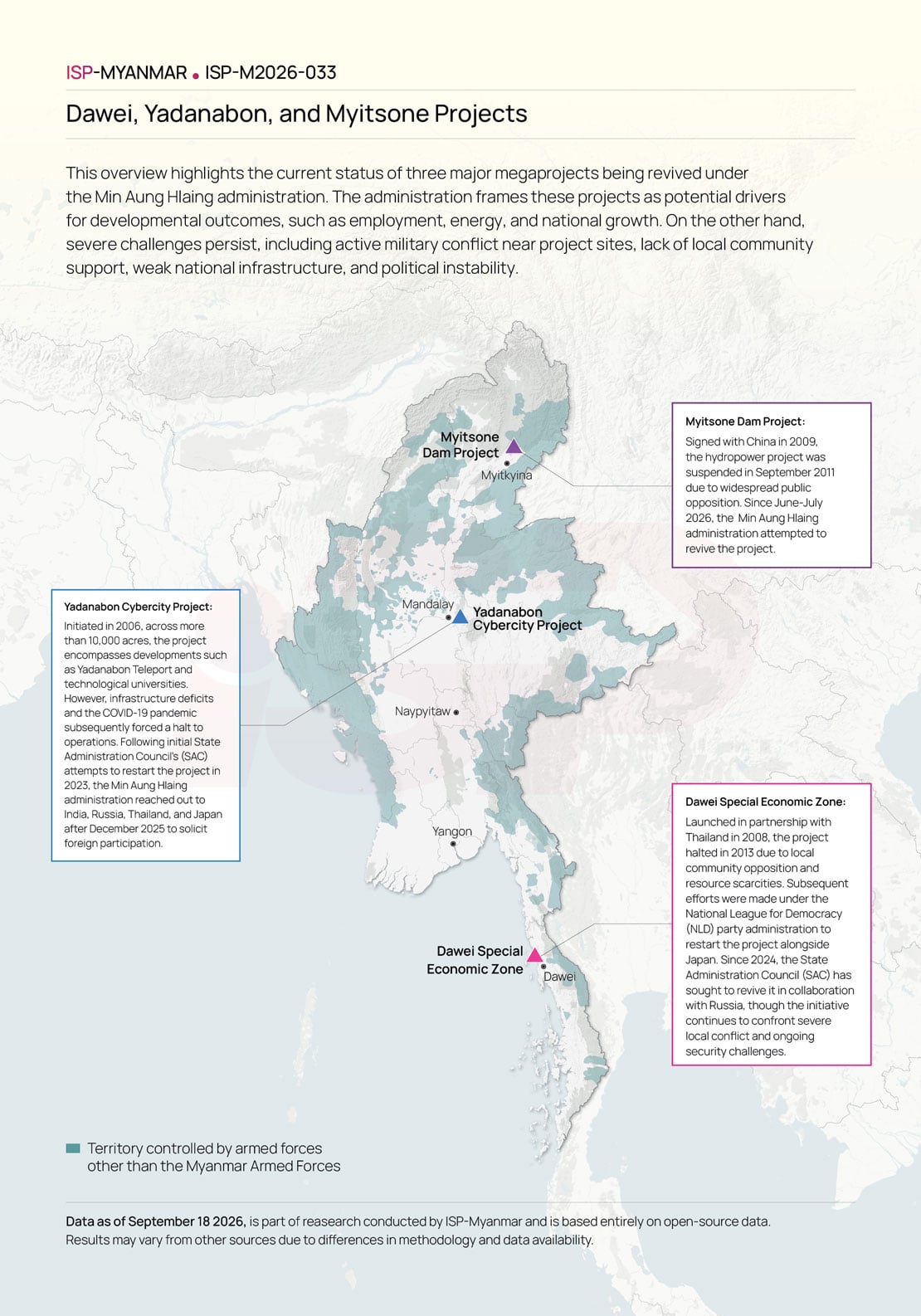
Among ongoing projects, we have highlighted three prominent ones: the Dawei Special Economic Zone (SEZ) project in the south, the Yadanabon Cyber City project in the central region, and the Myitsone project in the north. We will analyze and raise questions about these today. Today’s discussion is structured in two parts. The first part examines the background and current status of these megaprojects. The second part builds on the first part and questions whether these projects will genuinely contribute to development for the country and our people. Kaung San, please kick off the discussion.

Ko Kaung San
Panelist
ISP-Myanmar
First of all, I would like to discuss the Dawei Deep Seaport and SEZ project, which is geopolitically very significant. This project was initially initiated with Thailand in 2008 during Senior General Than Shwe’s tenure. However, due to local opposition and the inability to secure necessary financial resources in time, the project was suspended in 2013 under President Thein Sein’s administration. Later, under the NLD government, efforts to restart the project with Japan stalled.
Three years after the coup, the State Administration Council (SAC) has attempted to revive this project with assistance from Russia. Min Aung Hlaing said discussions are ongoing with Russia to build a deep seaport capable of docking 200,000-ton vessels. Just this past June, an MOU was signed with Russia to build a coal-fired power plant, which can be considered part of this overall project.
Another point I want to emphasize is that, unlike other projects, Dawei is strategically critical due to its geographic position. It connects with the Greater Mekong Subregion (GMS) Economic Corridor linking Mekong regional countries. Their objective also considers connecting the Dawei-Indian Ocean outlet in the west with the South China Sea outlet in the east. The primary intention is to reduce transit time compared to passing through the heavily trafficked Malacca Strait. As a result, besides Russia, countries like Japan and Thailand are also interested in the project, creating potential for investment from other nations. However, looking at the project as a whole, it includes a deep seaport, power and fuel plants, roads, and railways. Thus, the entire project requires massive financial investment. Most importantly, it lacks security guarantees. The project is located in Tanintharyi Region, where conflict is currently active. Armed groups are operating in the surrounding areas of the project. As shown in the slide, the Myanmar Armed Forces have been launching intense ground and air offensives this year to reclaim the areas surrounding the project. As a result, at least over 5,000 local residents have been displaced.
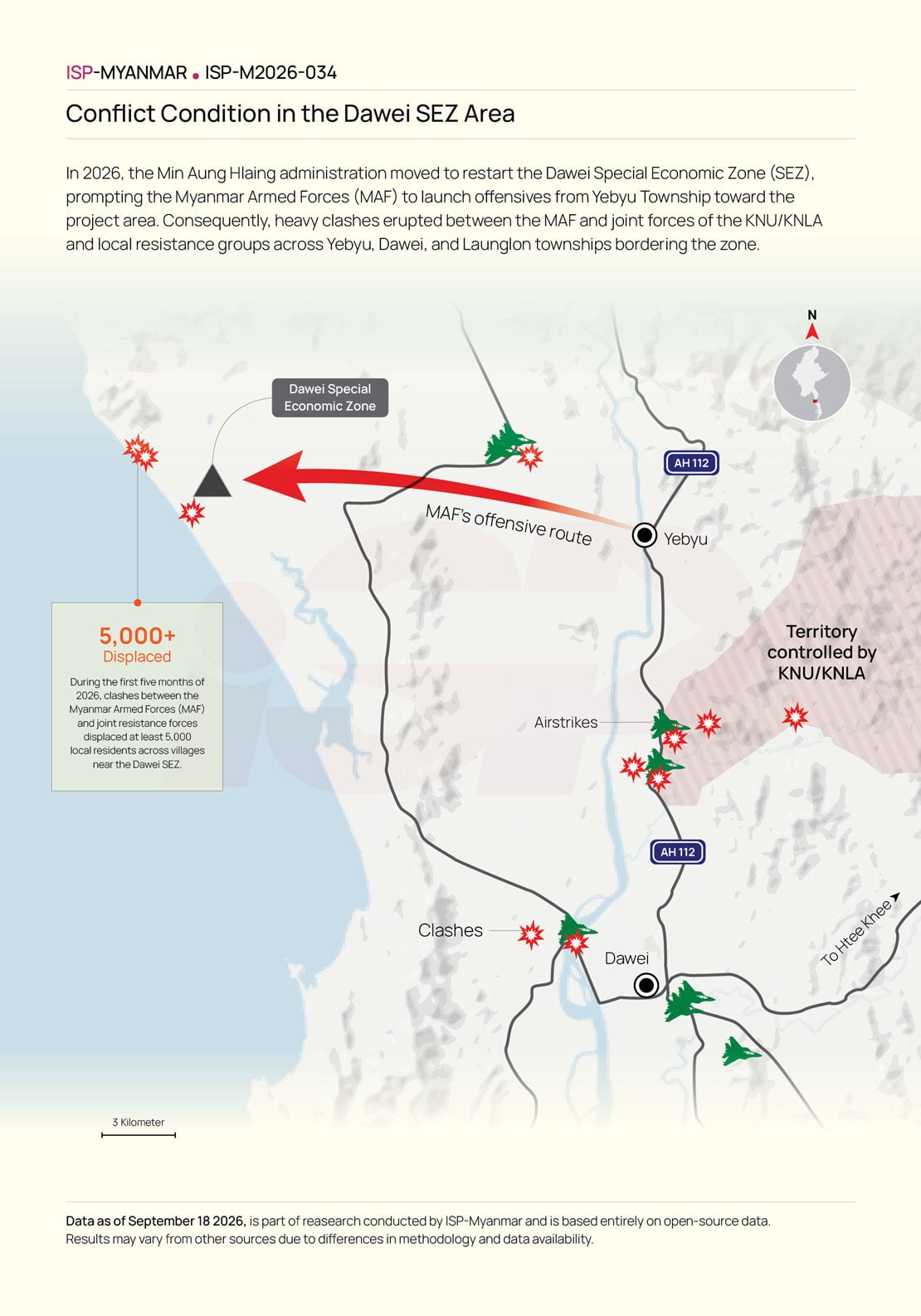
Therefore, while we see high potential returns, instability and a lack of security guarantees would make any country reconsider and evaluate massive investments. From our observations, even Russia itself has not taken concrete steps for components other than the power plant project. Additionally, the profit-sharing structure for this project remains unknown to date, which raises further questions. In summary, given severe security risks, high capital requirements, low transparency, and local hardship, the project’s overall feasibility remains highly questionable. Ko Chan, please continue with the Yadanabon Cyber City project.
Ko Chan
Panelist
ISP-Myanmar
Thanks, Kaung San. Kaung San covered the Dawei project. I would like to continue with the Yadanabon Cyber City project. This project was intended to drive our country’s technological development, envisioned as “Myanmar’s Silicon Valley.” However, whether it is realistic in practice remains debatable. Looking back, the project began around 2006 and was officially opened in 2007. It spanned over 10,000 acres and included major facilities such as Yadanabon Teleport, the University of Technology, and Yadanabon Cyber City. However, economic sanctions and infrastructure deficits stalled the project. Later, under the National League for Democracy (NLD) government, efforts resumed, but the COVID-19 pandemic halted progress again. Following the coup, around 2023, efforts were made to revive it. By around December 2025, the SAC government declared it would make the project a success. After assuming the presidency post-election, Min Aung Hlaing frequently invited investments for this project during foreign trips—specifically to India, Russia, Thailand, and Japan—and at business forums. He often pitched that the area is vast, the geography and climate are favorable, and intellectual property laws have been drafted, claiming that tech innovations can be conducted securely. Despite these invitations, internet freedoms remain severely restricted on the ground, and there is no stable currency or economic environment. Furthermore, following the military conscription law, the brain drain of skilled labor and professionals continues to pose major challenges.
Additionally, local residents in surrounding villages and religious buildings within the project site are being displaced. The gap between offering incentives and confronting harsh local realities casts deep doubt on the project. Moreover, despite repeated investment drives, no countries have expressed tangible interest so far. In my view, we must critically re-examine these issues. These are the main questions regarding the Yadanabon Cyber City project. Next, Mary, could you provide an analysis on the Myitsone project, please?

Mary
Panelist
ISP-Myanmar
Thank you, Ko Chan. The Myitsone Dam project is framed as an effort to address energy security and electricity shortages. However, the project site holds immense historical and cultural heritage passed down through generations of Kachin people. Myitsone represents the Kachin people’s identity and essence. The agreement for this project was initially signed around 2009. By September 2011, the project was suspended, primarily because it lacked public acceptance. Today, this project is being revived. But fundamental questions remain: how much will our country actually gain, and what benefits will the Kachin people receive?
Previously, electricity distribution was allocated as 90 percent to China and 10 percent domestically. As for revenue sharing, 70 percent went to China, 20 percent to Myanmar, and 10 percent to the broker. Given this history, questions remain about how benefits and revenue are currently structured. Furthermore, the Myitsone site is a living, valuable environment rich in both surface and underground natural resources. How will these resources be shared or managed?
Another question concerns the necessary infrastructure to generate and distribute electricity, which remains severely lacking. How are these infrastructure deficits being addressed? Therefore, we cannot view the Myitsone Dam project purely as a transactional trade-off between securing electricity and attracting investment. I want to emphasize that this directly impacts the survival of the community and the long-term strategic interests of the nation. As to whether these projects will truly deliver real development for the public, Kaung San will continue the discussion.
Ko Kaung San
Panelist
ISP-Myanmar
We notice a common pattern in all three megaprojects we just discussed. None of them has the foundational groundwork or conditions needed to turn these projects into meaningful national development for the public. As Ko Chan discussed earlier, genuine sustainable development can only emerge when political, economic, and social dimensions are harmonized. Thus, measures and ecosystems must balance these three aspects. Politically, is there stability, the rule of law, and functional, accountable institutions? Are policies predictable and reliable? Economically, does a reliable investment environment with properly functioning market mechanisms exist? Finally, on the social front, are robust safeguards protecting local livelihoods, social well-being, and the environment from project-induced harms? Only when these exist to a sufficient degree can we achieve development that benefits everyone.
Looking at the Dawei Special Economic Zone project, financial backing remains uncertain, and the operating environment is volatile. Active fighting has intensified, causing widespread displacement. In Yadanabon Cyber City, economic and technological infrastructure deficits, such as electricity shortages, scarcity of skilled labor, and land disputes, persist. Furthermore, mass evictions of residents and religious structures near the project site are taking place, while private vested interests remain involved.
As for the Myitsone Dam project, it remains disconnected from local and public consent, while infrastructure deficits persist. There are many limitations. As the Ayeyarwady River flows through the entire country, threats to its flow raise serious concerns for human security and societal survival. Another critical point is that even if these projects are completed, conditions may not fundamentally change. Without proper foundational conditions and ecosystems, completing these projects won’t generate developmental results, leaving projects disconnected from the people.
Everything we have discussed today represents a critical analysis of these megaprojects and development dreams. We highlighted Dawei, Yadanabon, and Myitsone. If even these three megaprojects raise so many questions, projects across the country surely warrant many more. We would like to conclude the first part of our discussion here. We now invite comments and questions from our attending audience.
Linn Htet
Event Host
ISP-Myanmar
Thank you to my colleagues for their presentations. We will now move on to the Q&A session. First, we would like to invite a question or comment from the audience. Please keep your comments concise. You can use the “Raise Hand” button to ask a question or share a comment. Let me invite hands now, does anyone have their hand raised? Please feel free to ask or comment. We do have a question submitted in the chat by Su Su Wai. Let me read it out: “Reflecting on the lessons from Dawei, Yadanabon, and Myitsone, what new standards should be established to define a development project as successful in conflict-affected Myanmar?” Panelists, please go ahead.
Ko Chan
Panelist
ISP-Myanmar
Thank you. As I mentioned before, development doesn’t magically happen simply by handing over land, inviting investment, and commencing construction. Our analysis suggests a tendency in our country to approach development projects with short-term, adhoc fixes rather than long-term planning. Instead, we must approach this with a long-term vision. Crucially, as I outlined earlier, there are three dimensions: resolving issues politically, establishing an open and stable market economy, and creating a harmonious, equitable social environment with proper regulatory frameworks. To build these foundations, we must operate with a long-term strategic vision. Only then can we foster truly people-centered development.
Linn Htet
Event Host
ISP-Myanmar
Thank you, Ko Chan. Does anyone else want to use the “Raise Hand” button to ask a question or comment? Please feel free to raise your hand. Alright, I will read one of the pre-submitted questions from our Gabyin community members. The question asks: “In a collapsing economy like ours, isn’t having a little investment better than having none at all? Even if a project has flaws, capital comes in, some jobs are created, and some infrastructure is built. Isn’t that better than complete stagnation?” Please address this question.
Mary
Panelist
ISP-Myanmar
I will address this question. Rather than arguing whether investment is inherently good or bad, we are questioning whether these projects truly benefit the nation and the public. In conflict zones, domestic and international legal frameworks to regulate these megaprojects are not functioning effectively. Under such conditions, can we trust incoming investments? If conflicts and environmental damage arise, who is accountable for resolving them? Furthermore, we must consider how project revenues are shared and address fundamental questions about equity for the public. As a citizen, I would say that if a megaproject doesn’t serve the people or the country, it shouldn’t exist. Thank you.
Linn Htet
Event Host
ISP-Myanmar
Thank you, Mary. Moving on to another question sent in the chat by Khin. Let me read it out: “When an era of post-war or new state configurations arrives, how will local state authorities prepare and negotiate contracts for projects like Kachin (Myitsone) or Tanintharyi (Dawei)?” Please address this question.
Ko Kaung San
Panelist
ISP-Myanmar
I will take this question. From what we observe under current circumstances, various states and regions are building their own units. In my view, we should approach this primarily through federal principles. Additionally, local initiatives should be designed based on local needs and aligned with inclusive federal principles. Given the current active building phase, it remains difficult to specify precise mechanisms at this stage. That is my view.
Linn Htet
Event Host
ISP-Myanmar
Thank you, Kaung San. In addition to questions, we also invite comments from the audience. Anyone wishing to comment can click the “Raise Hand” button. Does anyone wish to discuss? Alright, let’s proceed to another question: “Despite talk of these projects, have trade routes actually reopened?” Please address this.
Ko Kaung San
Panelist
ISP-Myanmar
I’ll take this one too. Despite ongoing talk of megaprojects, trade routes remain closed. At the border with China, while local trade occurs in areas controlled by EAOs, broader flows of goods along trade corridors remain nonexistent because of ongoing blockades. At the border with India, cargo flows remain halted due to armed conflict along trade routes. At the border with Thailand, although Asian Highway No. 1 was recently reopened, trade cannot operate normally because of policy barriers and practical difficulties. Furthermore, along the Dawei–Htee Khee trade route connected to the Dawei Deep Seaport, joint forces led by the KNU/KNLA control much of the road section. So trade is also suspended. From a nationwide view, ongoing combat and policy barriers continue to block the flow of goods. It’s also hard to predict when conditions might return to normal.
Linn Htet
Event Host
ISP-Myanmar
Thank you, Kaung San. Due to time limits, we will conclude the Q&A session here. Ko Chan, please provide the concluding remarks regarding today’s discussion.
Ko Chan
Panelist
ISP-Myanmar
In conclusion, the Min Aung Hlaing administration is trying to revive stalled megaprojects and frame them as development achievements. However, as we discussed, true development requires balancing three dimensions. First, examining the political dimension reveals widespread vulnerability. Our country lacks stability, and institutional binding capacity remains severely limited. Second, the economic dimension shows a lack of a stable market economy, and underlying economic foundations remain weak. Third, regarding the social dimension, our community remains highly vulnerable and poorly protected, with equity unfulfilled. Forcing the revival of megaprojects under such fragile conditions makes achieving anticipated benefits exceedingly difficult. Under these conditions, development risks becoming entirely disconnected from the people. Therefore, unless a project delivers real benefits to the people, long-term sustainability will remain elusive. With that, I would like to conclude today’s session.
Linn Htet
Event Host
ISP-Myanmar
Thank you to Ko Chan for the concluding remarks. In addition to the data presented today, you can access our research findings free of charge on our website www.ispmyanmar.com and our social media pages. Thank you to all Gabyin members who attended today. We now conclude today’s “30 Minutes with the ISP” program.
Appendix Questions
The question listed below was submitted via chat during the “30 Minutes with the ISP” event on September 19, 2026.
It appears these megaprojects are being awarded exclusively to diplomatic allies. Could there be motives beyond the projects themselves, favoring personal interests over national interest?
This raises two main questions. First, as discussed before, foreign direct investment plummeted after the coup. Consequently, this reflects an effort to attract capital from countries with which they currently maintain favorable diplomatic relations. Second, literature on authoritarianism notes that regimes unable to obtain electoral legitimacy often utilize megaprojects and infrastructure as tangible outputs and grand symbols to manufacture “performance legitimacy.” Furthermore, regimes frequently award these contracts to favored cronies and associates to secure their loyalty. Therefore, these initiatives could represent much “more than just projects.”