
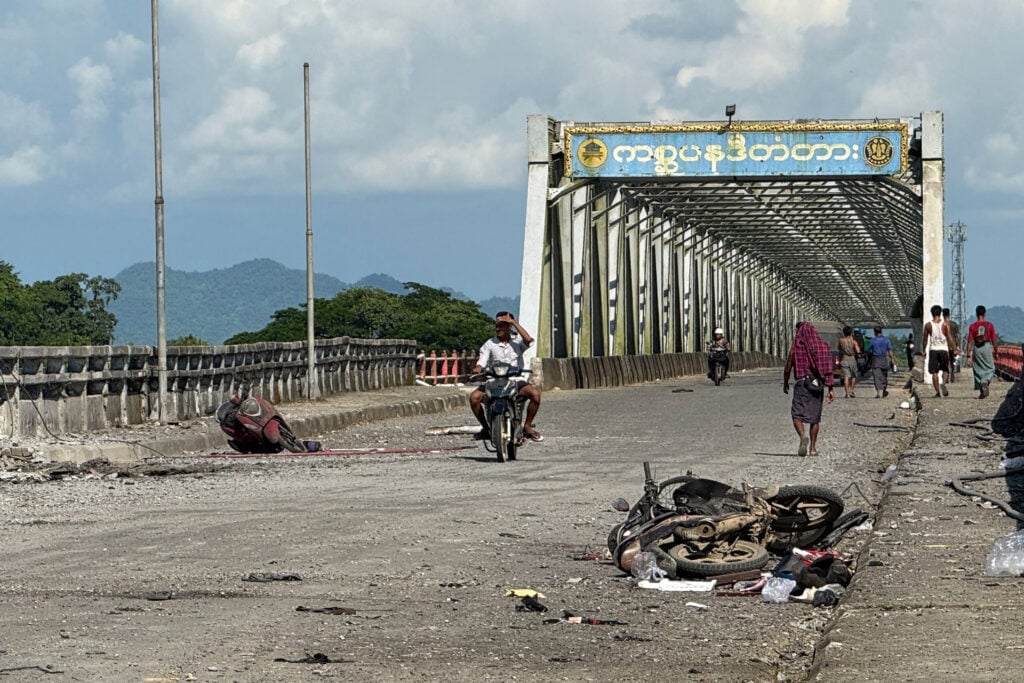
Photo – AFP
[This is a human-supervised, AI-assisted translation of the original Burmese ISP Column article by Mra Shin, published on October 1, 2026. Read the original Burmese Column here.]
At 12:10 PM on September 28, 2026, the Myanmar junta’s air forces dropped a 500-pound bomb on Kyauktaw, a town controlled by the ULA/AA, followed by another at 12:15 PM. One struck the local market called “India Market”, while the other hit the Kissapanadi Bridge. Stepping outside after the bombardment, the sight was one of lingering, smoldering smoke. The sounds were of chaos, frantic running, and weeping. Anxious crowds spilt into the streets, desperately seeking news from those fleeing the blast zones. The runners bore a grim message: “The India Market in Kyauktaw has been directly hit”. From the lips of market vendors who had managed an early escape, and men and women running so hard they forgot to breathe, came variations of a single, haunting sentiment: “I am lucky enough to still have the chance to see my family again”. Before they could even articulate these words, they ran amidst sounds of wailing and agonizing screams.
The India Market is a major hub supplying food, vegetables, clothing, shoes, and other consumer goods—both retail and wholesale—across Rakhine State. The vendors there included internally displaced persons (IDPs), locals, and unemployed people who had migrated from other towns to sell goods and make a living. Among them, the working-class IDPs were day laborers living hand-to-mouth. The bombing caused widespread death and injury to a diverse range of people: merchants and vendors from other towns preparing for travel in various vehicles, children inside the market, heavily pregnant women, and the elderly. Goods painstakingly accumulated through hard-earned savings and buildings were entirely consumed by fire, turning into ash in an instant.
When the junta’s air force dropped the 500-pound bomb on the market, the buyers and sellers had nothing to fight back against the aircraft except the food in their hands. As news of the India Market being bombed spread across the region, acquaintances began reaching out. Questions poured in relentlessly: “My sister-in-law went shopping there and we can’t reach her,” or “The boat didn’t leave today, so she was staying near the India Market. How can we contact her?”. Checking online revealed numerous posts begging for help, complete with photos, pleading, “We can’t contact someone from this township”. Under the current circumstances, there remain many unidentifiable bodies, their origins unknown, and many others lost to the flames.
In northern Shan State, during times when they lack a military advantage or wish to pressure for a ceasefire, the junta typically targets civilian areas to maximize casualties, attempting to force the populace to pressure resistance groups into a truce. However, this tactic is unlikely to work in Rakhine. It will only compound the resentment.
Besides the India Market, the bomb that fell over the Kissapanadi Bridge created a gruesome scene of dead pedestrians. In one of the most horrific instances, a nine-month pregnant woman, whose body was already engulfed in flames, the baby fell from her womb, only for the infant to be incinerated by the bomb’s fire. In another incident, a family of three selling shoes was torn apart when the child begged for Falooda, a dessert; the mother said, “Wait here, I’ll go buy it,” leaving her son and husband behind, who were then burned to death. The tragic tale of Patacara’s grief, once only heard in stories, is now a living nightmare unfolding on the ground. There are many others who perished in various, equally devastating ways.
According to the ULA/AA’s current statement, 50 people were killed, and 22 were severely injured. Only some of the dead could be identified by name and hometown, while others were damaged beyond recognition. This was the hellish experience the people of Kyauktaw endured on September 28. Unable to fight a conventional war and failing to gain a military advantage over the AA on the ground, the junta is deliberately and systematically massacring civilians en masse. Similar massacres of civilians have occurred in the Anyar (Dry Zone) region and other conflict zones.
In northern Shan State, during times when they lack a military advantage or wish to pressure for a ceasefire, the junta typically targets civilian areas to maximize casualties, attempting to force the populace to pressure resistance groups into a truce. However, this tactic is unlikely to work in Rakhine. It will only compound the resentment. The surge in Rakhine public participation in the ULA/AA following the violent crackdown on protesters in Mrauk-U in 2018 is a prime example. The ULA/AA’s declaration that they will soon retaliate against the organizations and individuals directly responsible for targeting civilian areas, including the Kyauktaw incident, further confirms this.
Mra Shin volunteers at a civil society organisation in Rakhine State.
[The views and opinions expressed here do not necessarily reflect the policies or positions of ISP-Myanmar. Readers wishing to share reflections or offer counterarguments are welcome to write and submit a rebuttal article.]