
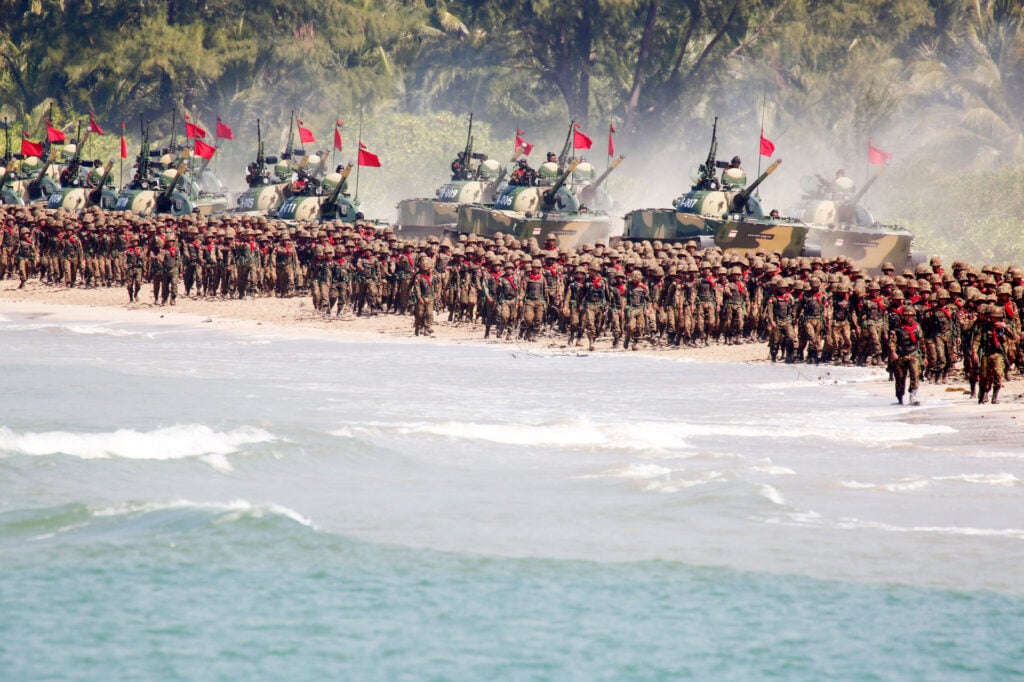
Photo – AFP
This On Point No. 6 (2026 Series) was published on October 9, 2026, as an English translation of the original Burmese version released on October 5, 2026.
Events
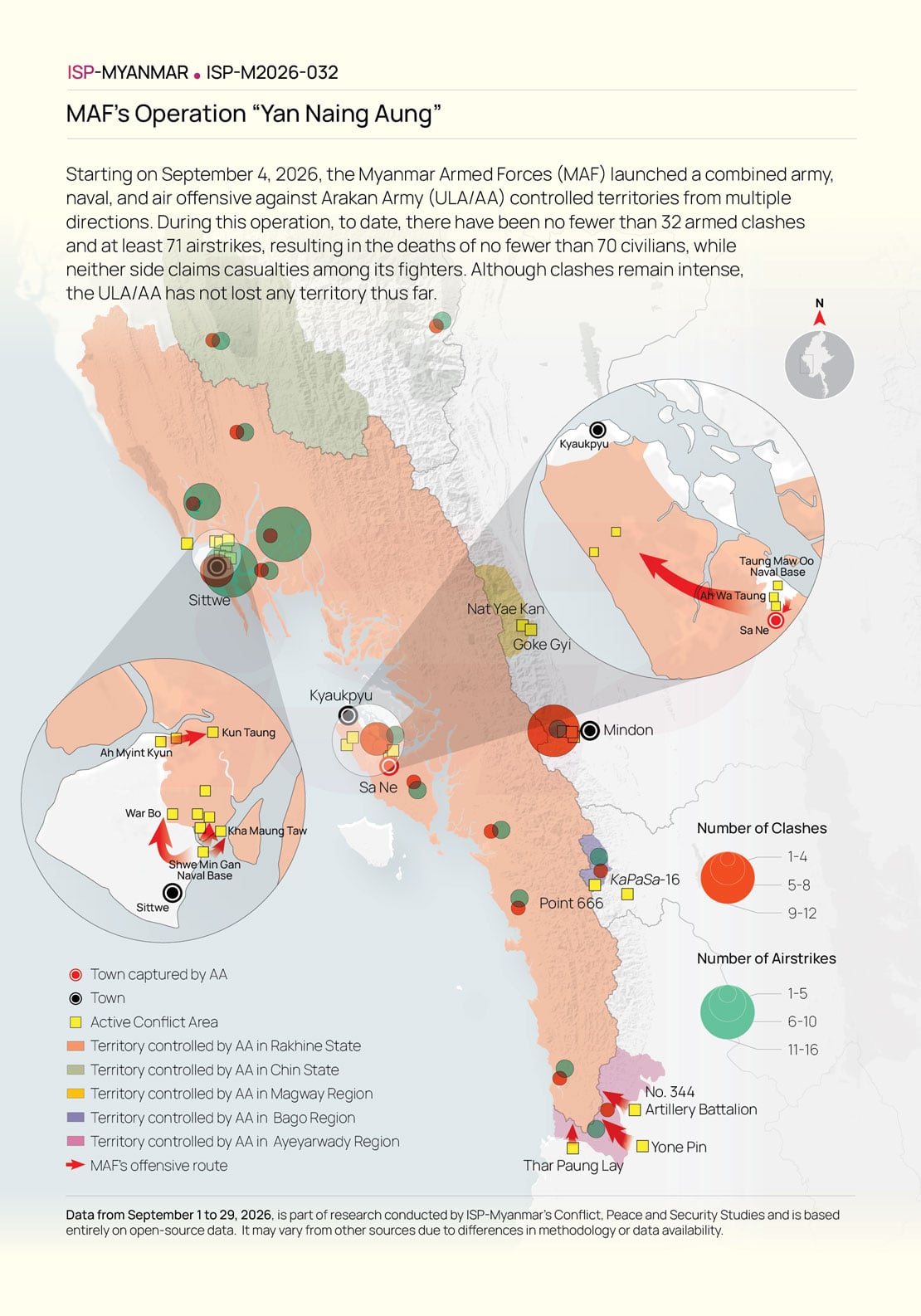
In early September 2026, the Myanmar Armed Forces (MAF) launched a combined army, naval, and air offensive against Arakan Army’s (ULA/AA) controlled territories, utilizing approximately 2,000 infantry troops across multiple routes. Since September 4, fierce clashes enraged in Kyaukpyu, Sittwe, and Ponnagyun townships in Rakhine State, as well as in adjacent areas including Mindon and Saw townships in Magway Region, Padaung township in Bago Region, and Yegyi and Lemyethna townships in Ayeyarwady Region. Although Naypyitaw has not officially announced this operation, its supporters refer to it as “Operation 4926” or “Operation Yan Naing Aung”. Despite daily intense clashes, the ULA/AA has not lost any territory thus far [See ISP-M2026-032].
Preliminary Analysis
The MAF’s operation to launch an offensive on ULA/AA-controlled territories can be analyzed in three phases.The first phase is the preparation for the offensive. The MAF has been preparing for the Rakhine front since late 2025. Even prior to the current operation, the MAF had bolstered its coastal naval presence and sustained heavy shellings and airstrikes. In late August 2026, simultaneous troop reinforcements were conducted via naval and land routes alongside ongoing airstrikes. During that period, reinforcements were deployed via Shwethaungyan town in Ayeyarwady Region to the ULA/AA-controlled areas of Baw Mi and Ma Gyi Zin villages, as well as to the Defense Industry Factory-16 (KaPaSa-16) area in Padaung Township, Bago Region.
Additionally, massive reinforcements were deployed to the Defense Industry Factory-12 (KaPaSa-12) in Thayet Township, Magway Region, the Taung Maw Oo naval base in Kyaukpyu Township, Rakhine State, and the Shwe Min Gan naval base in Sittwe Township. The newly reinforced troops include battalions under the No. 66 Light Infantry Division (LID-66) based in Inn Ma, western Bago Region; the No. 101 Light Infantry Division (LID-101) based in Pakokku, Magway Region; the No. 17 Military Operations Command (MOC-17) based in Mongpan, southern Shan State; and the No. 20 Military Operations Command (MOC-20) based in Khamaukgyi township, Tanintharyi Region. Furthermore, as the ULA/AA has captured Kyauktaw and Buthidaung towns, battalions under the Kyauktaw-based No. 9 Military Operations Command (MOC-9) and the Buthidaung-based No. 15 Military Operations Command (MOC-15)—which had to relocate their headquarters to Sittwe and Kyaukpyu—are also involved, totaling an estimated strength of around 2,000 troops. Quoting some local residents of Ramree and Gwa, BBC Burmese reported on September 9 that no fewer than 10 naval vessels are stationed near townships such as Sittwe, Ramree, Thandwe, and Gwa.
MAF’s Airstrikes In Rakhine
More than five years following the coup, the Myanmar Armed Forces (MAF) has conducted no fewer than 982 airstrikes in Rakhine State, resulting in the deaths of at least 661 civilians. The MAF’s airstrikes have fired at not only military targets but also civilian areas such as schools, religious buildings, hospitals, IDP camps, and their surrounding vicinities, leading to numerous mass killings. In the post-coup period, there have been at least 16 incidents of mass killings involving 10 or more civilians in Rakhine State, 12 of which were caused by airstrikes. On September 28, 2026, an MAF’s airstrike near the India Market and the Kissapanadi Bridge in Kyauktaw Township, Rakhine State, killed no fewer than 50 civilians. This death toll marks the deadliest incident for civilians caused by an airstrike in Rakhine State. After General Ye Win Oo became the Commander-in-Chief of the MAF, the command authority for airstrikes was decentralized down to the regional military commander level. The MAF also shifted its tactics, flying in formations of five to seven aircraft to conduct more intense airstrikes than before. Since Gen. Ye Win Oo assumed command, there have been at least 325 airstrikes in Rakhine State, making it the second-highest targeted area nationwide. Specifically, 90 percent of these airstrikes have targeted 14 townships controlled by the ULA/AA.
The second phase can be seen in the initial military operations. Maj. Gen. Kyaw Zaw, who previously served as the regional operations commander (Division Commander) at the Pekon-based No. 7 Military Operations Command (MOC-7), became the commander of the Western Regional Military Command (RMC) in April 2026. Because the ULA/AA has captured Ann town, where the Western RMC was based, the current RMC commander is operating out of the Regional Operations Command (Sittwe) to direct the offensives. Subsequently, in April, attempts were made to launch amphibious operations in Kyaukpyu, Thandwe, Toungup, and Gwa townships. Offensives with a force of around 1,000 troops were also conducted in June and July in Paletwa, Mindat, and Matupi townships in southern Chin State, which borders Rakhine State. In early August, the MAF suffered heavy losses, including the death of a battalion commander, during a battle near the border of Mindat and Kanpetlet townships. Afterwards, the southern Chin State offensives slowed down. However, on September 20, around 1,000 troops were additionally reinforced at the Defense Industry Factory-25 (KaPaSa-25) near Laung Shey town in Magway Region, bordering southern Chin State.
The third phase is accelerating the operation. Starting September 4, a total of seven columns launched offensives: three columns at the border of Sittwe and Ponnagyun townships, one column from the Taung Maw Oo naval base in Kyaukpyu township, and one column each in three locations within Ayeyarwady Region, as well as Bago and Magway Regions. During this offensive, naval vessels along the coast provided heavy shelling support, while airstrikes were fiercely executed. The ULA/AA mounted an unyielding defense, and in some areas (especially the Sittwe-Ponnagyun border), the ULA/AA launched sudden counter-offensives. Both sides were seen using First Person View (FPV) drones extensively in this operation. The clashes between the MAF and the ULA/AA in Rakhine State are taking on the intense, strategic nature of a total war, different from the low-intensity conflicts (guerrilla warfare) seen in other regions. The ULA/AA employs a warfare style focused on capturing towns and bases and waging positional warefare for ground control. The MAF, on the other hand, are utilizing combined army, naval, and air operations alongside a blockade warfare strategy to completely recapture and control lost territories. In recent history, such massive offensives were also seen during the capture of the Karen National Union (KNU)’s Manerplaw headquarters (1992-1995) and the Laukkai battle (2015) against the Myanmar National Democratic Alliance Army (MNDAA) led by Peng Jiasheng.
China’s response to this current operation is also noticeably apparent. Specifically, while operations were intense on September 10, Mr. Jia Junjie, Minister-Counselor of the Chinese Embassy in Myanmar, arrived in Kyaukpyu and met with Chinese business people. During the meeting, he stated that the Chinese government always prioritizes the security of its citizens abroad. The physical appearance of Chinese officials in a conflict zone during ongoing fighting can create pressure on the ULA/AA. Prior to this, Bangladesh-based New Age news agency reported on August 7 that Mr. Sasakawa, Honorary Chairman of the Nippon Foundation of Japan, was attempting to facilitate an unconditional meeting between Naypyitaw and the ULA/AA. Before the coup, in November 2020, with Mr. Sasakawa’s mediation, the MAF and the ULA/AA reached an informal ceasefire using the election as a pretext. This ceasefire lasted until July 2022. Clashes resumed afterward, and another ceasefire was brokered with Mr. Sasakawa in November 2022, which held until “Operation 1027” launched on October 27, 2023.
Scenario Forecast
In this current operation, civilian casualties are likely to rise further as the MAF conducts a combined army, naval, and air offensive. From September 4 to the present, at least 70 civilians have been killed by airstrikes and heavy artillery strikes. At least 6,000 people have been displaced from about 24 villages across the four townships of Kyaukpyu, Sittwe, Ponnagyun, and Rathedaung. According to a report published by the United Nations Office for the Coordination of Humanitarian Affairs (UNOCHA) in 2025, 18.5 percent of Rakhine State’s population (nearly 468,100 people) were already war refugees. Among the many potential situations in these territories, there are three possible scenarios likely to take shape.
The first scenario is that the battles in Rakhine State seem to have taken on the form of a total war. Consequently, they differ from conflict dynamics in other regions, and atrocities could become more prevalent. For the MAF, the Rakhine front is crucial for both prestige and strategic reasons. Therefore, they are launching a massive offensive with thousands of troops to reclaim all or parts of the ULA/AA-controlled territories. Additionally, civilian targets are also being attacked without distinguishing them from military targets, leading to a rise in both mass killings and the number of internally displaced persons (IDPs). Although the conflict has intensified into a total war, the MAF has not yet been able to regain territorial control. Besides Rakhine State, the MAF has to deploy large numbers of troops to the Bhamo front in Kachin State in the north and the Hpapun and Myawaddy fronts in Karen State in the southeast. In the short term, the MAF is unlikely to deploy sufficient reinforcements to shift territorial control on the Rakhine front; instead, it will likely rely on mandatory conscription to address personnel shortages.
The second scenario envisions a potential loss of momentum in the ULA/AA and allied forces’ territorial expansion as they defend against military counter-offensives. ULA/AA’s advances previously targeting Defense Industry Factory No. 14 (KaPaSa-14) in Magway Region, Defense Industry Factory No. 6 (KaPaSa-6) in Bago Region, and No. 344 Artillery Battalion in Ayeyarwady Region have shifted into a defensive posture under the MAF’s latest push. Consequently, as ISP-Myanmar analyzed in December 2025, capturing the MAF’s defense industry facilities remains a formidable challenge for the ULA/AA and its joint forces [See ISP Stakeholder Tracker (ST2025-04)].
A third scenario envisions mounting socioeconomic strain within ULA/ AA-controlled areas, driven by rising civilian casualties and widespread displacement. As thousands of displaced individuals attempt to leave Rakhine State for better prospects, they face strict movement restrictions imposed by the ULA/AA. On August 29, the ULA/AA reported prosecuting over 30 cases involving human trafficking and unauthorized departures during the first eight months of 2026. Should fighting intensify and displacement grow, the ULA/AA will likely tighten legal enforcement to stem civilian outward migration. Compounding these dynamics, the conflict has transcended conventional military operations, with partisan factions actively waging an online propaganda war, heightening the risk of broader, ethnically charged tensions.
ISP On Point
Myanmar Military’s Offensive on Rakhine: Preliminary Analysis and Three Scenarios