
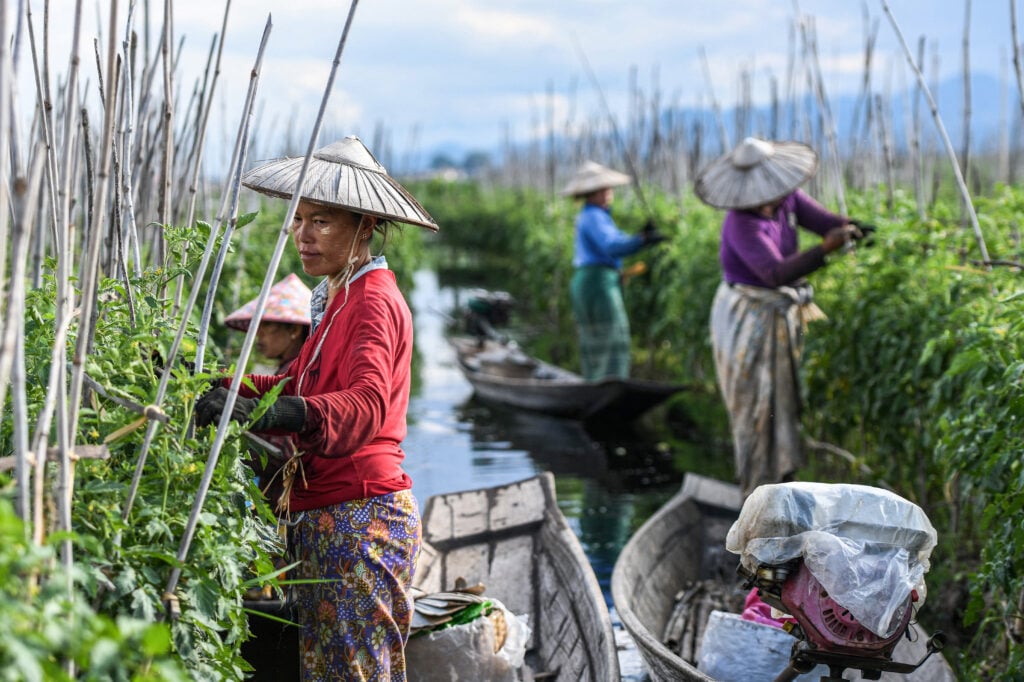
Photo – AFP
[The views and opinions expressed here do not necessarily reflect the policies or positions of ISP-Myanmar. Readers wishing to share reflections or offer counterarguments are welcome to write and submit a rebuttal article.]
Arguments on the politics of presence are particularly relevant to the struggle for women’s political participation. Women’s presence in political institutions matters because political representation is not simply a question of who speaks for whom; it is also a question of who is present, whose experiences are visible, and whose interests can enter political decision-making. At the same time, the scholars also caution against assuming that women constitute a politically homogeneous group or that the presence of women automatically produces outcomes favorable to women. Women have different identities, experiences, interests and political positions.
This distinction is important in Burma. The case for women coming together as women does not require women to be the same, to think alike, or to share a single political agenda. Rather, it rests on the recognition that women occupy a particular material, embodied and political position in society. These commonalities provide a legitimate basis for solidarity even when women profoundly disagree with one another.
▪️Women do not need to be the same in order to stand together
There is no single “women’s interest.” Women experience power and oppression differently depending on ethnicity, class, age, geography, disability, political affiliation and many other circumstances. A Karen woman, a Shan woman, a Bamar woman, a young woman and an older woman may have very different political priorities.
But difference does not make the category of women politically meaningless. Women can disagree about politics while still recognizing that they are situated within social and political structures that have historically treated women as a subordinate group. Phillips (1998) herself distinguishes between the diversity of women’s political interests and the significance of women’s shared position. Gender composition can be an enabling condition for bringing experiences and concerns into political decision-making, even though it cannot guarantee a particular political outcome. The objective, therefore, should not be sameness among women, but solidarity without sameness.
▪️Women share not only political experiences, but embodied human realities
There is another dimension that should not be lost in political debates about gender: women are embodied human beings.
Pregnancy, childbirth, postpartum recovery, menstruation, breastfeeding, reproductive health and menopause are material realities of human life associated with the female body. Not every woman experiences all of them, and women experience them very differently. Nevertheless, these realities cannot simply be reduced to political identity or treated as matters of discourse.
They become political because societies determine who bears their consequences, who receives care and protection, whose health is prioritized, and whether women have the resources and autonomy necessary to live with dignity.
Pregnancy is biological; whether a woman can receive safe maternal healthcare is political. Childbirth is biological; whether she survives it is also a question of health systems and social conditions. Postpartum recovery is biological; whether she is supported or left to carry the burden alone is a social and political question.
Reproduction is human; who has control over reproductive decisions is profoundly political. Thus, defending women’s interests cannot be limited to representation in political institutions. It must also recognize the material conditions of women’s lives.
▪️In conditions of violence and conflict, the distinction becomes especially important
In Burma’s present circumstances, women’s bodies and lives are affected by conflict in particularly gendered ways. Sexual violence, reproductive health needs, pregnancy and childbirth during displacement, lack of maternal healthcare, care responsibilities, and insecurity in humanitarian settings demonstrate that women’s protection cannot be separated from the realities of their bodies and lives.
This gives women an additional reason to organize collectively: those who experience these realities must have the political capacity to articulate them and defend the conditions necessary to live with dignity. This does not mean that only women can understand or advocate for these issues. Men and institutions have important responsibilities. But women should not have to depend upon others to decide whether these concerns deserve political priority.
The case for women coming together as women does not require women to be the same, to think alike, or to share a single political agenda. Rather, it rests on the recognition that women occupy a particular material, embodied and political position in society.
▪️Women’s solidarity is therefore a form of political agency
If women are affected by political decisions in ways that are partly specific to their position as women, women need collective political capacity to make those realities visible. This is not an argument for women to withdraw from broader political struggles or to create a separate political world. On the contrary, it is an argument for ensuring that women enter those struggles as political actors rather than merely as beneficiaries, victims, supporters or symbolic representatives. Women can therefore say that we do not need to agree on everything to stand together as women. But we need enough solidarity to ensure that women’s safety, dignity, political participation and leadership are never treated as expendable.
▪️Solidarity should protect difference, not eliminate it
Coming together as women should not require women to surrender their other identities or political commitments. A woman does not cease to be Karen, Shan, Bamar, working-class, rural, urban, young, older, a person with disability, religious or politically different when she comes together with other women. The purpose of solidarity is not to erase these differences. It is to create a political space in which women can bring those differences into collective action without allowing those differences to prevent collective agency altogether.
In this sense, we do not come together because we are all the same. We come together because, despite our differences, there are material, embodied and political realities that affect us as women.
▪️Conclusion
The political argument for women’s collective action should therefore rest neither on the claim that all women share one interest nor on the assumption that gender alone determines political identity. A more meaningful proposition is that women are diverse, but women’s diversity does not erase the significance of being women. Women can share a political space without sharing a political ideology. They can disagree without abandoning one another. They can recognize different experiences while defending common minimum conditions of safety, dignity, health, political participation and agency.
For Burma’s transition, this matters now. The political culture created during the struggle will shape the political order that follows. If women are expected to wait until democracy is achieved before organizing collectively as women, they may arrive at that future political order without the political power necessary to shape it.
The principle, therefore, is not sameness, but solidarity; not exclusion, but agency; not one “women’s interest,” but women’s capacity to articulate and defend the multiple realities of women’s lives. And perhaps the most fundamental proposition is that women should not have to choose between being different women and standing together as women. We can do both.
M. Mutraw is a former Lauterpacht International Law Fellow (University of Cambridge) and is currently an Advisor to the Karen National Union.
Bibliography
Phillips, A. (1998). Quotas for Women. In The Politics of Presence (pp. 57–84). Oxford University Press.